Dust collector size: the duct decides, not the motor
Size the duct before the machine. At the pressure a small shop blower makes, a 4 inch line carries about 350 CFM and a 6 inch line about 785 CFM, while the fine dust figure is near 1000 CFM. No normal blower delivers that volume and the air speed that keeps the duct clear at the same time, on any pipe size. Serious fine dust collection therefore becomes a question about the impeller and the motor together, and the horsepower the machine is sold on does not answer it.
A collector is sold on a maximum its blower never sees in a working system, because a working one runs at about half the pressure the blower could make. The 1.5 hp unit whose chart says 1100 CFM delivers about 785 CFM on 6 inch duct, about 550 CFM on 5 inch and about 350 CFM on 4 inch. Bill Pentz goes further and reports small shop vendors selling equipment that moves about half the maximum airflow they advertise, so read the ladder below off a measured number and ignore the advertised maximum.
What decides it, in order
Work down these. Each one narrows the answer, and the first is the one most buying guides skip.
Are you collecting chips, or fine dust as well?
These are two different engineering targets that differ by about three times the airflow, and Pentz's complaint is that small shop vendors keep mixing the two standards. Almost every other choice in the chain follows from which one you picked.
- Chips and sawdust
- About 350 CFM at the machine covers nearly every stationary tool in a small shop. A 4 inch line delivers this and a 1 hp collector is enough motor, before a long run or ribbed flex hose eats into it.
- Fine dust too
- Near 1000 CFM, close to three times as much, because catching particles that move on a breath means flooding the working area rather than sucking at a port. Pentz reads the blower tables as needing at least a 3 hp collector or a 5 hp cyclone before 1000 CFM appears at all, and says none of that class holds the air speed to go with it. Budget for an oversized impeller and motor.
What is the narrowest pipe, hose or port in the path?
Once the duct is undersized it sets the airflow instead of the blower. This constraint makes horsepower shopping pointless. Most buying guides never mention it.
- 4 inch
- About 350 CFM. A 3/4 hp blower manages roughly 300 CFM here and a 2 hp unit rated at 1200 CFM is lucky to reach 450 CFM, so most of what the bigger motor can do never arrives.
- 5 inch
- About 550 CFM, which is ample for chip collection at almost every small shop machine and a long way short of the near 1000 CFM fine dust figure. The air engineering guidance still puts a chip system on 4 inch, because at the 350 CFM a chip system is designed around, 5 inch loses the air speed that keeps a vertical run clear.
- 6 inch
- About 785 CFM, the practical ceiling for a normal blower, and still short of 1000. Below 3 hp the air speed also falls far enough that vertical runs start to plug.
What port did the machine actually ship with?
The tool is usually the bottleneck, not the pipe you buy. A port that suits chip collection is routinely undersized for the same machine's fine dust requirement on the day it arrives.
- A single 4 inch cabinet port
- Supports about 350 CFM where the charts ask 550 CFM below a table saw blade for fine dust. Opening that port to a full 5 inch is the first move and rarely the last one.
- A cabinet port plus an overhead guard
- Aim for the two branches together matching the area of the main that feeds them, slightly over rather than under. Pentz's chart picks 4.5 inch beside a 4 inch guard on a 6 inch drop, and since he could not affordably get 4.5 inch he runs 5 inch, about 14 percent over.
- A 2.5 inch blade guard port
- Pentz gauged one of these at 183 CFM against the 350 CFM his chart wanted for that hood. He fixed his own by fitting a bigger guard with a 4 inch port. Where the port cannot easily be modified, as on chop, miter and radial arm saws, his answer is a shop vacuum on the small port and the collector on a separate large hood, both running together.
Does the run go up, along, or both?
Air speed is what keeps the duct clear. Treat it as a fire safety question first and an efficiency question second. This constraint is why a bigger main can perform worse than a smaller one.
- Short horizontal runs
- Target 3000 FPM. Below about 2800 FPM the run stops carrying material and builds piles.
- Vertical drops
- Target 4000 FPM, which is where a 4 inch line at 350 CFM already sits. Below about 3800 FPM a vertical run starts plugging, and larger chips want up to 4500 FPM.
- A 4 inch drop into a 6 inch main
- The common mistake. That 350 CFM arrives in the 6 inch main at 1783 FPM, well under the floor, so the main fills until the remaining area is narrow enough to carry the air.
Is there a separator in the line?
Everything that makes the air turn costs airflow, and the cheap fixes cost the most. Worth settling before any motor decision, because the losses here are larger than the ones horsepower recovers.
- Nothing, straight to the collector
- The published fan curve is as close as you will get to what the machine actually delivers, and Pentz would still have you measure it.
- A trashcan lid separator
- Pentz gauged one taking a real 1100 CFM down to under 450 CFM on a 6 inch test pipe. The number comes from his shop and is no design figure. It is also a bigger loss than half a horsepower recovers.
- A designed cyclone
- Costs some airflow, and Pentz reports his own separating material out before it reached the impeller. He still glued magnets into his floor sweep to catch nails before they got that far.
350 CFM. That is what a 4 inch duct carries at the pressure a small shop blower actually generates, and it barely moves when you buy a bigger motor. A 3/4 hp blower on 4 inch pipe manages about 300 CFM. A 2 hp collector rated at 1200 CFM is lucky to give 450 CFM through the same pipe. Dust collector size, read off the label, is close to meaningless until the ductwork is settled.
Most numbers here are Bill Pentz's, from his ducting work. Some are air engineering tables he cites, others are readings he took in his own shop with gauges, and each figure below says which. OSHA covers the health side, quoted and never stretched.
The two standards nobody separates
Chip collection means the sawdust and offcuts you would otherwise sweep up. Almost every stationary tool in a small shop gets good chip collection at 350 CFM, and that requirement has been well understood since the 1920s.
Fine dust collection is a different target. Those particles are invisible without magnification and light enough that any air movement scatters them, so catching them at the source means surrounding the working area of the tool with moving air instead of pulling at a port. Run the arithmetic on that and it lands near 1000 CFM for most stationary machines, close to three times the chip figure.
The dust collector CFM on a box describes neither, because a working system runs at about half the pressure its blower could make, and Pentz goes further: small shop vendors, he says, ship about half the maximum airflow they advertise.
The health case here is two separate claims. OSHA carries wood dust with an IARC classification of carcinogenic to humans, Group 1, and an NTP classification of known to be a human carcinogen, and adds that western red cedar dust has been shown to cause asthma. It also says, on its overview page, that "The extent of these hazards and the associated wood types have not been clearly established", and ties the classification to no particle size. So the argument that the invisible fraction is the one that matters is Pentz's, not OSHA's, and it rests on other endpoints: work he cites finds every fine dust exposure costs measurable respiratory capacity, building toward asthma, COPD and emphysema.
Where dust collector size finally matters
Once the duct diameter is settled, the motor sets a ceiling. A 1.5 hp collector whose chart says 1100 CFM delivers about 785 CFM on 6 inch duct, about 550 CFM on 5 inch, and about 350 CFM on 4 inch. Which of those you get is decided by the pipe. Whether 785 CFM is on the table at all is decided by the motor.
He gives that 6 inch figure as 785 CFM in four places and as 875 CFM twice, once generally and once as a reading off his own 14 inch impeller. Everything below uses the 785 he repeats and reasons from.
Notice that 785 CFM is not 1000 CFM.
Pentz spells out what a normal blower does with that. Go to 7 inch duct and the 1000 CFM is available, because a wider pipe resists less, but air speed then drops below what keeps a vertical run clear and it plugs. Stay at 6 inch and the runs stay clear at 785 CFM.
Three horsepower is the floor for keeping that 6 inch run clear at all, and the blower tables want 3 hp or a 5 hp cyclone before they show 1000 CFM anywhere. Neither of those buys both at once. Pentz says there were no small shop collectors or cyclones that resolved it, so he stopped shopping horsepower and built an oversized impeller and motor instead. His own cyclones and the Clear Vue units use that combination to move a real 1200 CFM through 6 inch duct with air speed to spare. Anyone whose chain ends at fine dust plus 6 inch has not finished the decision.
Past that there is a wall, and it is why the horsepower chart is a trap. Doubling the air moved requires four times the static pressure and nine times the horsepower. Adding half a horsepower and a larger impeller to that 1.5 hp 1100 CFM blower nets about 100 CFM.
The table saw case, in numbers
A cabinet saw arrives with a 4 inch port in the cabinet. That supports about 350 CFM, and the charts ask 550 CFM for fine dust below the blade, which is where most of a table saw's dust goes. Opening it to a full 5 inch is the first move and rarely the last. Pentz got his own saw there with a larger down drop split into two hoses, an added overhead hood, and then a 4 inch hose inside the cabinet that also had to come up to 5 inch. That 550 CFM is one port's share of a machine total near 1000.
Overhead guards are their own problem. Pentz gauged a 2.5 inch blade guard port at 183 CFM against the 350 CFM his chart wanted for that hood, and replaced the guard with a larger one carrying a 4 inch port. For tools whose port cannot easily be modified, mostly chop, miter and radial arm saws, his answer is not a bigger collector either: it is a shop vacuum on the small port and the dust collector on a separate large hood, both running at once.
Going larger is not automatically better either, which is where this gets counterintuitive. The Wood Whisperer enlarged a table saw cabinet port from 5 inch to 6 inch to match the main trunk, then added an overhead guard with a 3 inch port, and finished with more branch area than the main could feed. His own conclusion afterward was that leaving the saw at 5 inch most likely would have collected better.
The two sources word the rule differently, and the gap decides what you buy. He keeps the summed branches no greater than the main, within reason. Pentz aims to match or slightly exceed it, off a chart: on a 6 inch drop that gives a 4.5 inch cabinet port beside a 4 inch guard, within a percent of the main. He could not affordably get 4.5 inch, so he runs 5 inch, about 14 percent over. We follow Pentz, because he sizes both branches on purpose where a rule of thumb only says when you have gone too far. The Wood Whisperer's 6 inch and 3 inch ran about 25 percent over: the difference between compromising and overshooting.
The pile in the pipe
Air speed is the half of this that is a safety question. Below about 3800 FPM a vertical run starts plugging, and larger chips want up to 4500 FPM. Below about 2800 FPM a horizontal run stops carrying material and builds piles, so the design targets are 4000 FPM vertical and 3000 FPM horizontal.
A 4 inch drop feeding a 6 inch main is the usual way to break this. The 350 CFM that line carries arrives in the 6 inch main at 1783 FPM, in a 7 inch main at 1310 FPM, in an 8 inch at 1003 FPM. The main then fills until the leftover area is tight enough to carry the air, and OSHA says significant accumulations of fine wood dust can be a fire and explosion hazard. When flow comes back, the pile moves at once and takes joints and filters with it.
What the cheap fix actually is
Unless fine dust is the target, nothing above argues for a bigger collector, and the order of returns is roughly the reverse of what gets bought. Open the machine's port. Shorten and straighten the run. Swap ribbed flex hose for smooth wall, several times less resistance per diameter. Then take the trashcan separator out: Pentz gauged one of those lids pulling a real 1100 CFM down to under 450 CFM on a 6 inch test pipe. His shop, not a design figure, and still a loss of over 600 CFM against the 100 CFM half a horsepower buys.
If a separator has to stay, a cyclone costs airflow and buys something back. Pentz reports his own separating material out before it reached the impeller, which matters because a steel screw hitting an impeller can put a spark in the collection bin. He said it worked well, and still glued magnets into his floor sweep to catch nails before they got that far. Separately, and apart from sparks, most dust collectors are poor vacuums because their air speed is too low for pick up.
Sizing questions settle most shop purchases, so they get a full page here. A paragraph inside a ranked list would not hold them. The rest of the category board works the same way, and how the evidence is graded explains what a number here has to clear.
Questions people actually ask
- Will a bigger motor fix bad dust collection?
- Rarely on its own, because the pipe usually sets the airflow. Doubling airflow takes four times the static pressure and nine times the horsepower, so adding half a horsepower and a bigger impeller to a 1.5 hp 1100 CFM blower buys about 100 CFM. Opening the machine's port and straightening the run returns more for less. Fine dust is the exception where the motor matters, and even there horsepower alone does not settle it. The tables want 3 hp or a 5 hp cyclone before they show 1000 CFM at all, and Pentz says none of that class holds the air speed that keeps the duct clear while delivering it. What does both is an oversized impeller and motor.
- What size dust collector do I need for a table saw?
- For chips, anything that delivers 350 CFM at the saw, which a 1 hp unit on 4 inch duct does. Fine dust is harder. The charts want 550 CFM below the blade alone, which means opening the cabinet port to 5 inch, and the machine total sits near 1000 CFM once the overhead guard is counted. A normal blower gets there only on 7 inch duct, at the cost of vertical runs that plug.
- Is 4 inch duct ever the right answer?
- Yes, for chip collection. A 4 inch line at 350 CFM sits right at the 4000 FPM air speed that keeps vertical runs clear, which is why chip collection systems are built around it. For fine dust it is the wrong pipe, and a bigger motor on it buys far less than the label suggests.
What that lands on
Machines that satisfy the chain above. The condition is on each one, because a machine that is right for one answer is wrong for another.
We earn a commission on qualifying purchases through the links here, at no cost to you. It never decides what makes the list.
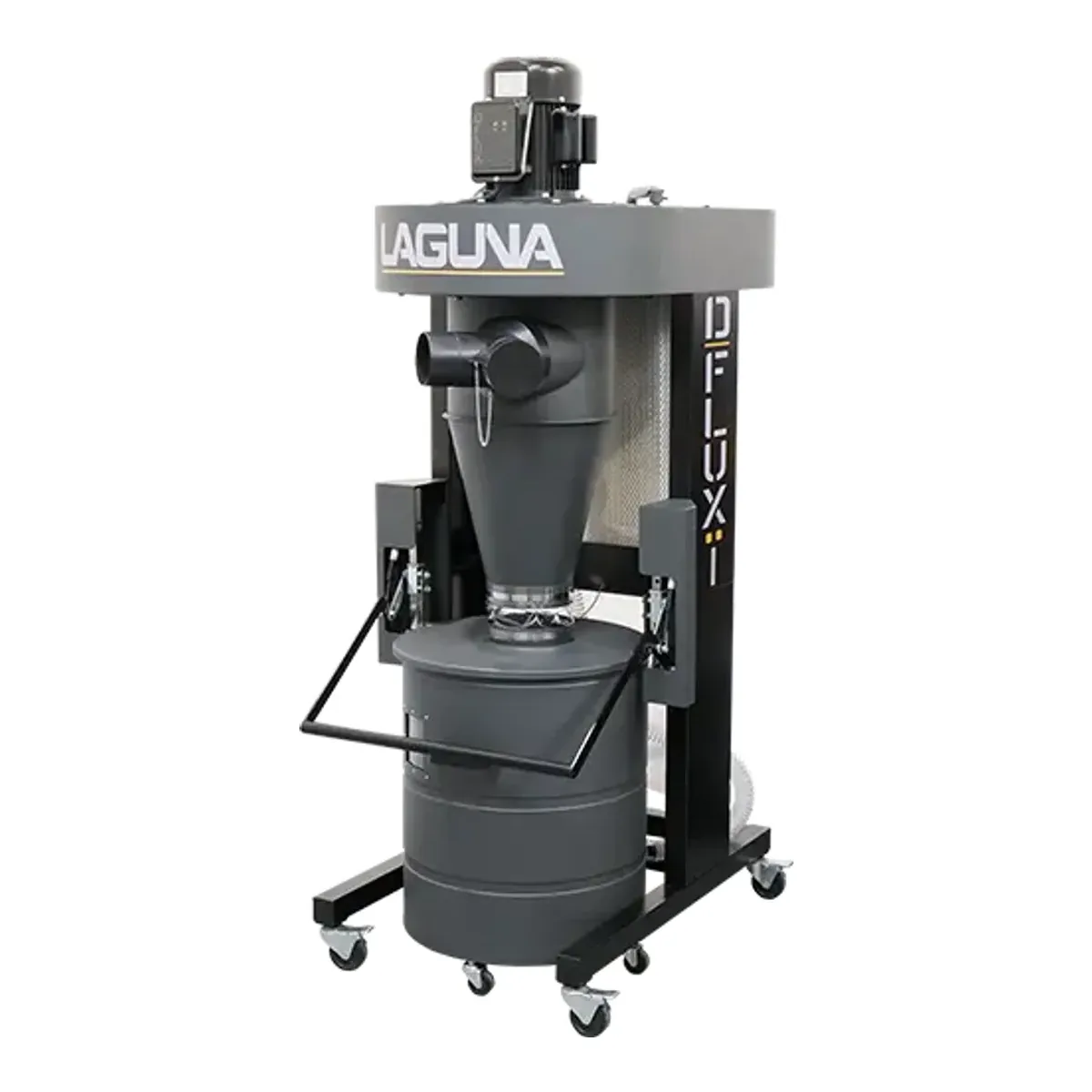
Laguna D|Flux 1
Right when the target is chips and sawdust at about 350 CFM and you want a two stage cyclone that runs on a standard outlet. A bag collector chosen on horsepower is the wrong buy here. The load drops into the drum before it reaches the impeller.
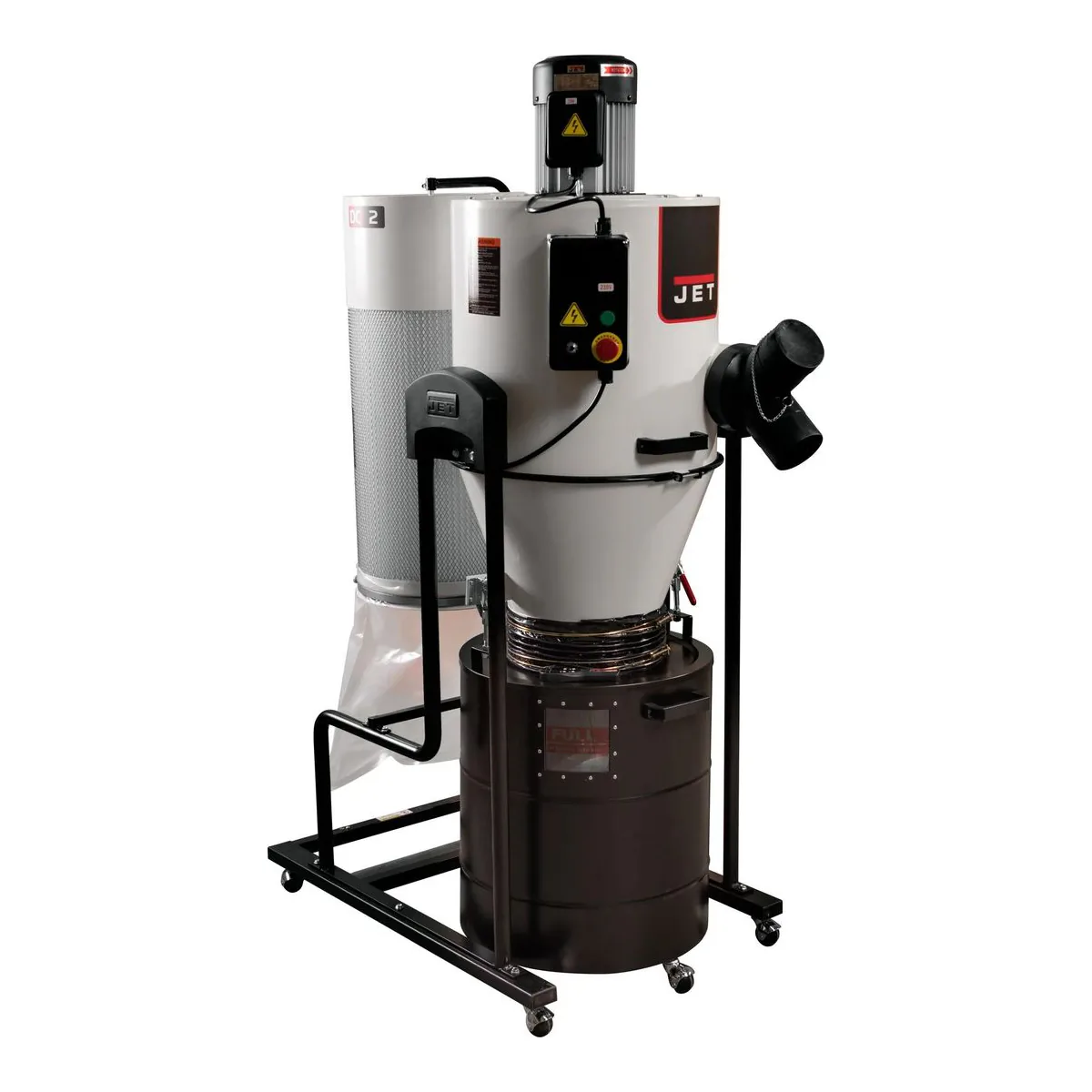
JET JCDC-2
Right when you are past a single 1 hp chip unit and want a cyclone that feeds a 6 inch main or splits to two 4 inch drops for more than one machine. It is not the 3 hp the tables want for fine dust, so read it as chip collection with headroom. It is not the fine dust answer.
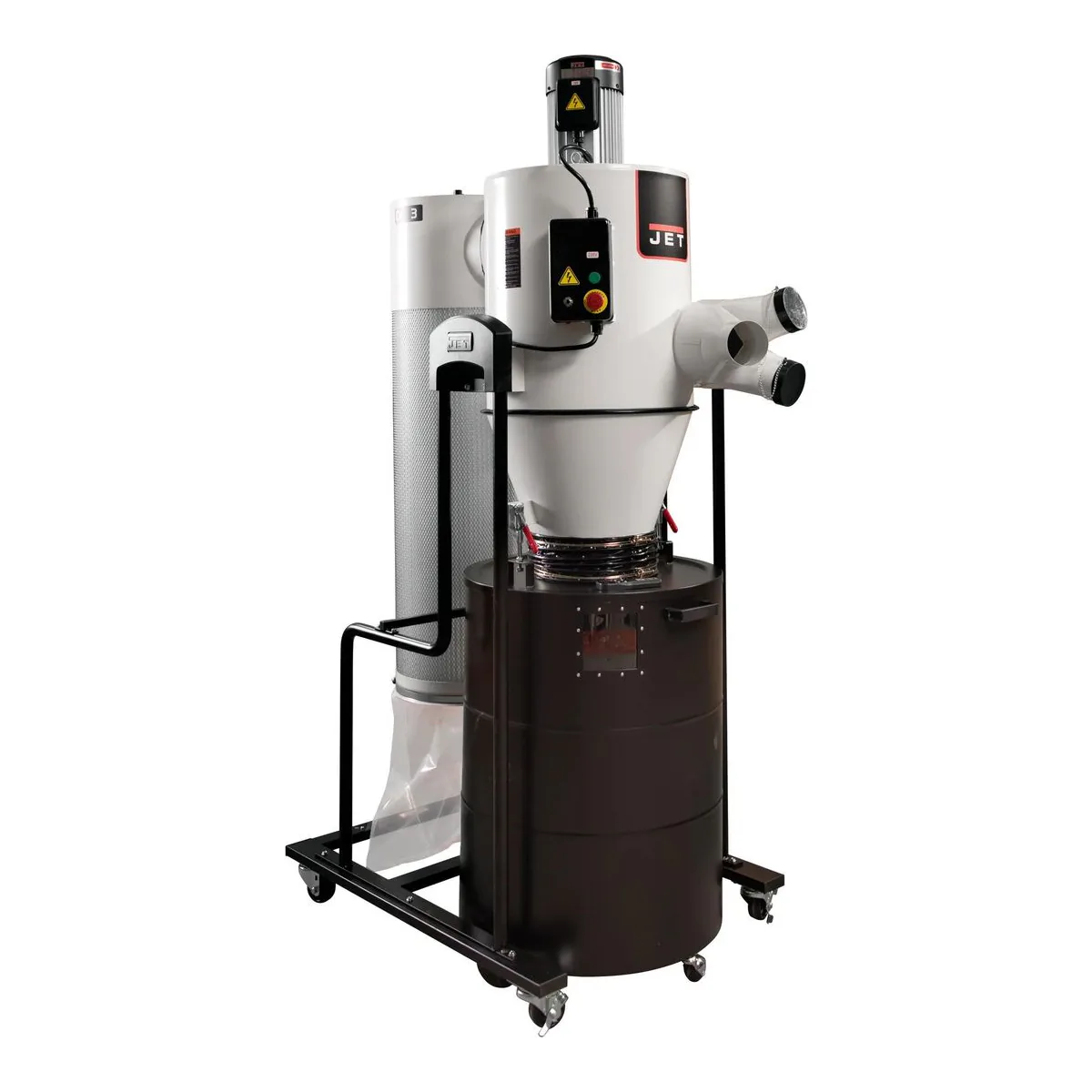
JET JCDC-3
Right when fine dust is the target and the chain runs past the 785 CFM a normal blower reaches on 6 inch toward the near 1000 CFM figure. This is the 3 hp cyclone the blower tables ask for before 1000 CFM appears at all, though holding the air speed at that volume is still the open problem described above.