Advance Paris A12 Classic review vs Apex
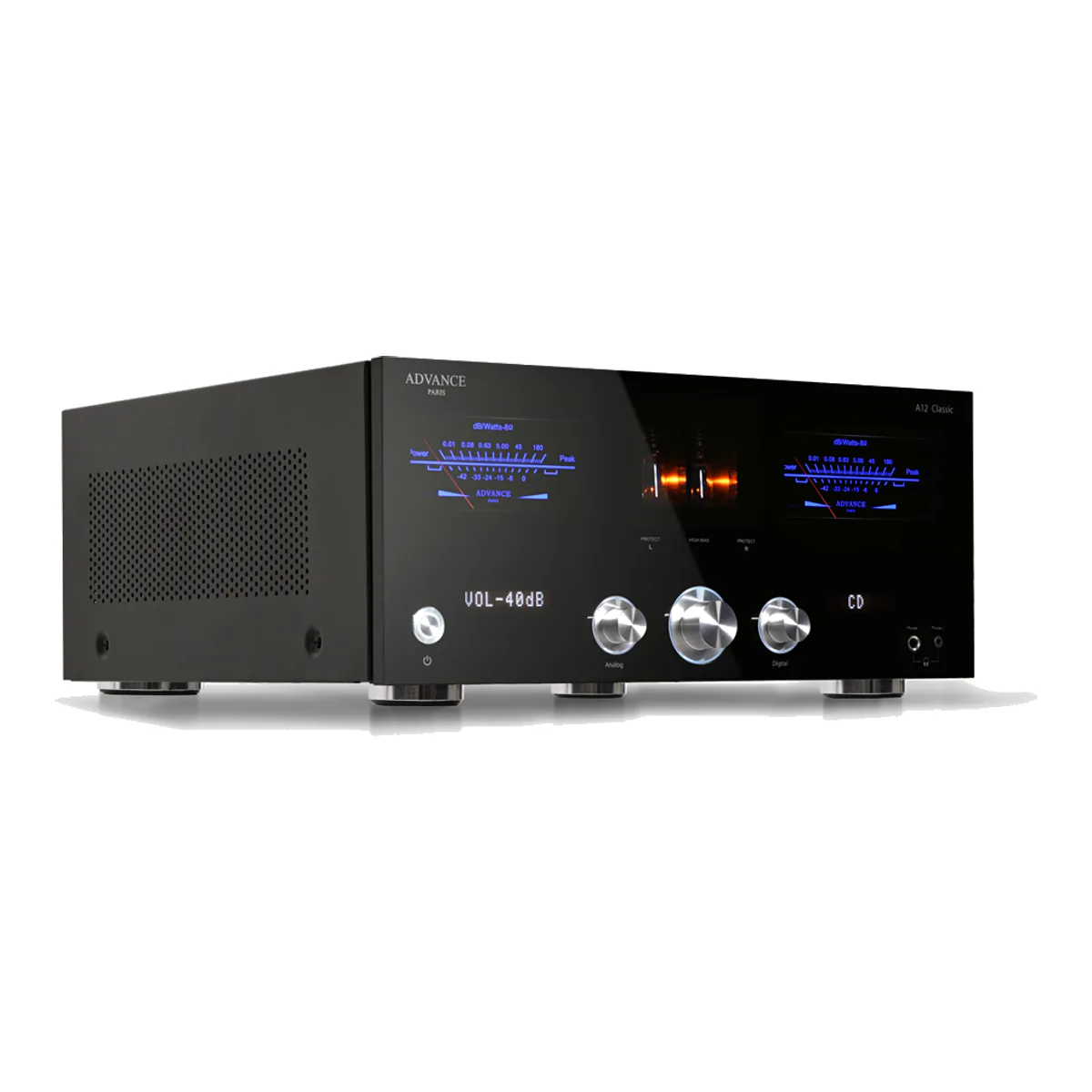
The Advance Paris A12 Classic connects more sources than most systems own, moving-coil vinyl and HDMI included, behind tube-lit glass and VU meters. SECRETS found its HDMI audio input sounded worse than USB. If your TV is the main source, the A12 Apex's eARC socket with CEC and its newer converter make it the better fit on paper.
- Output power 2 x 190 W RMS into 8 ohms and 2 x 280 W RMS into 4 ohms, Class A/B
- Dual mono design with 2 toroidal transformers
- Preamplification with 2 integrated tubes, 12AT7, with a warm-up of approximately 30 seconds
- TI Burr-Brown PCM1796 DAC, 24 bit and 192 kHz
- Phono input for MM and MC cartridges
- 5 analog RCA inputs and 2 balanced XLR inputs
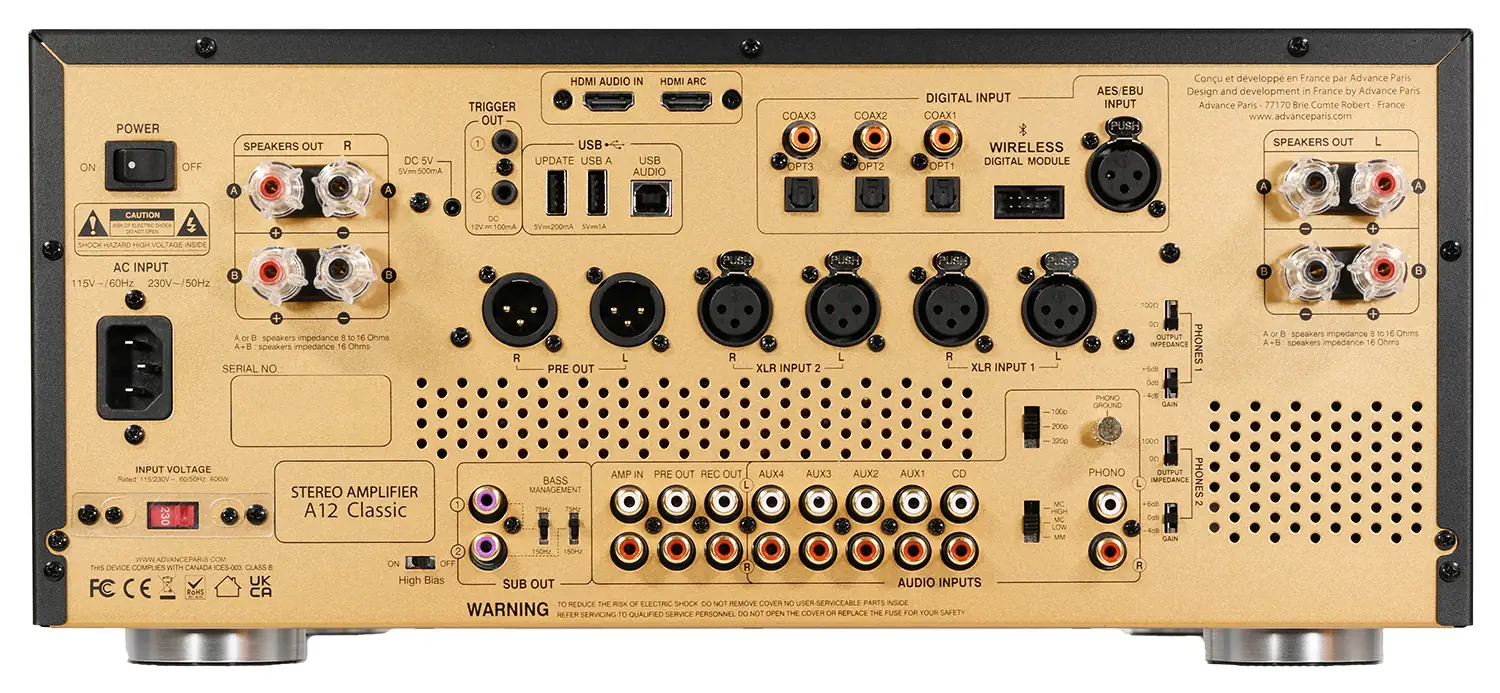
- 3 optical, 3 coaxial, AES/EBU, USB Type B, USB Type A, HDMI audio input and HDMI ARC
- Pre-out in balanced XLR and unbalanced RCA, plus 2 subwoofer outputs
- High Bias switch: the sound is comparable to that of a Class A amplifier on the first watts of use
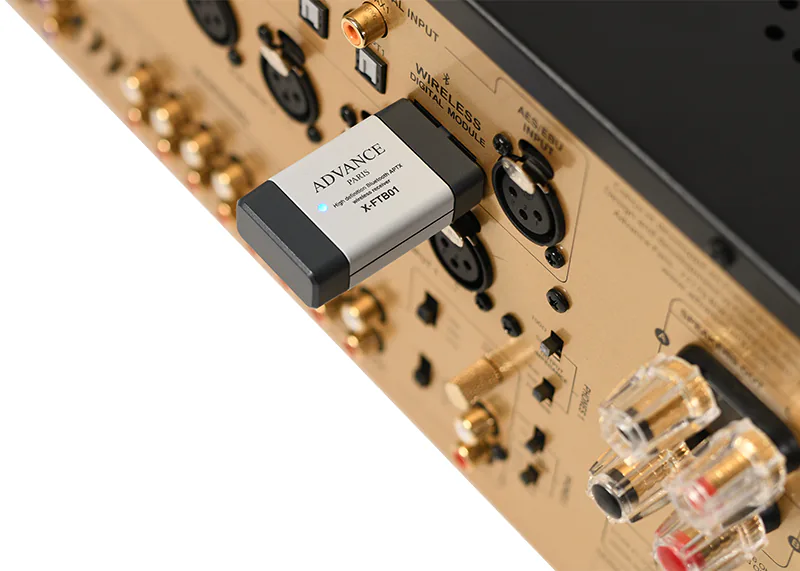
- Bluetooth through an optional X-FTB01 (aptX) or X-FTB02 (aptX HD) module
We earn a commission on qualifying purchases through the links here, at no cost to you. It never decides what makes the list.
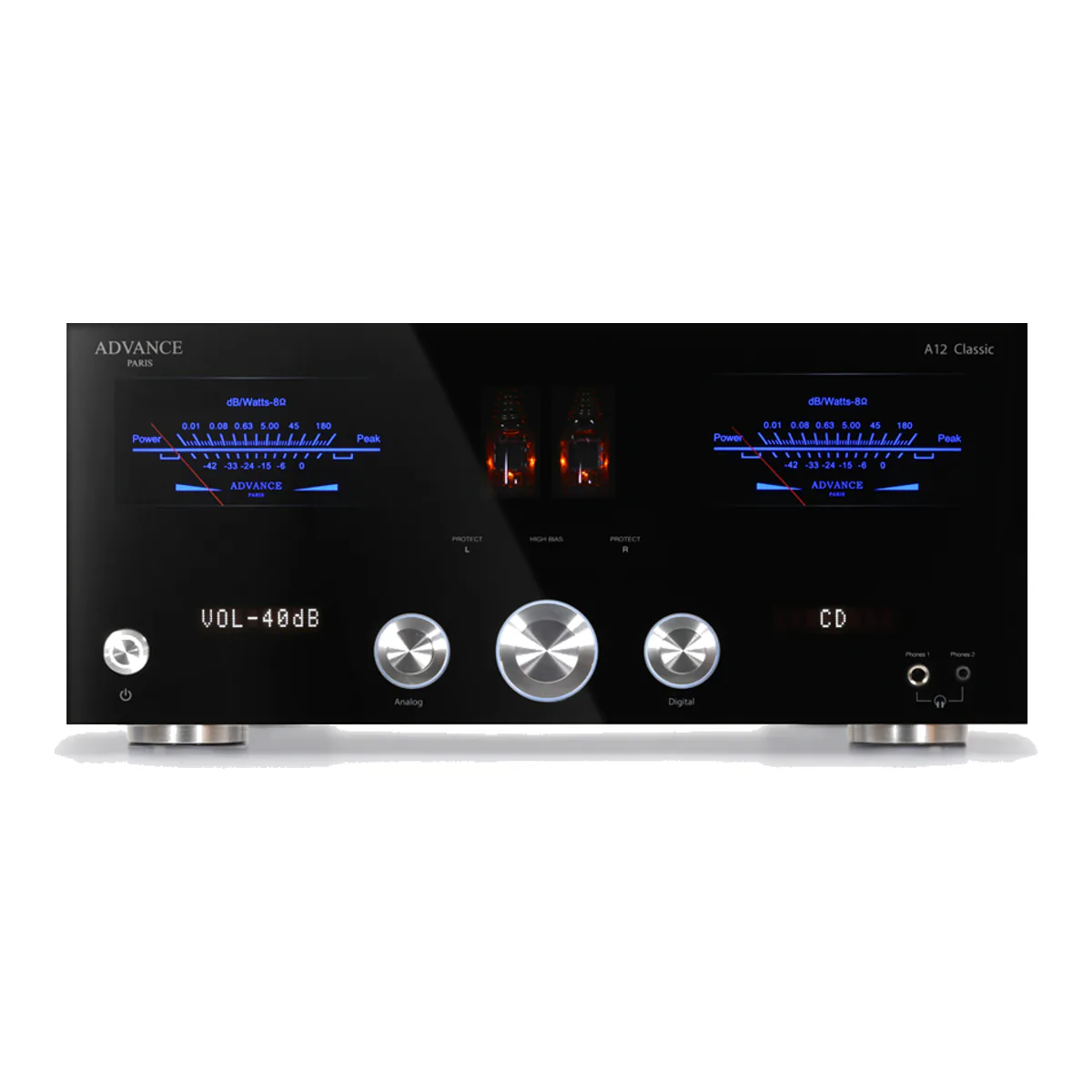
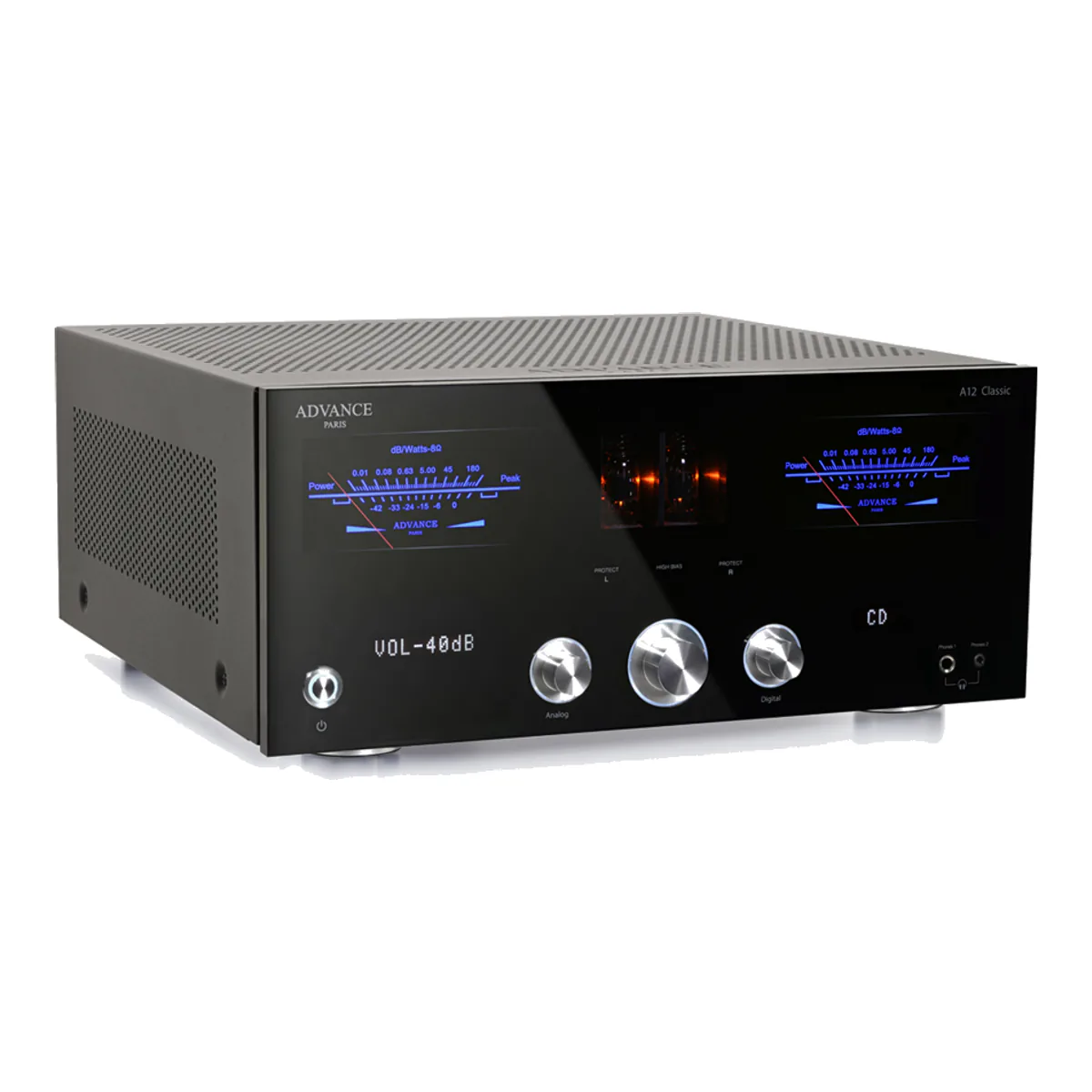
Count your sources before anything else. If the list runs to a turntable with a moving-coil cartridge, a CD transport, a streamer and a television, the Advance Paris A12 Classic takes every one of them in a single chassis: a moving-coil phono stage with switchable gain and loading, five RCA line inputs, two balanced XLR pairs, three coaxial, three optical, AES/EBU, USB and an HDMI ARC socket for the TV. It is a hybrid integrated amplifier, two tubes glowing in a window between the meters ahead of a solid-state output stage.
Which of those sources you use most sets the alternative. If it is the television, look at the A12 Apex, whose datasheet is dated 09/2025 and which carries a newer converter and an eARC socket. If it is a moving-magnet turntable and two or three line sources, the smaller A10 Classic covers you. Both sit with the rest of our stereo integrated amplifier coverage.
Behind this verdict: Advance Paris's manual and datasheets, five published listening reviews, and 25 people on YouTube review threads who say they own or owned an advance paris a12.
What the A12 Classic's 190 watts leaves out
The rating is 190 watts per channel into 8 ohms and 280 into 4. None of the three Advance Paris documents we read for the Classic, the product page, the datasheet and the manual, gives the distortion level, the test frequency or how many channels were driven for that figure. The A12 Apex datasheet does: its 190 W is at 1 percent THD+N, 1 kHz, two channels running.
The tiny distortion number on the Classic's product page, 0.007 percent, carries no conditions at all. The only conditions Advance Paris publishes for a figure that low are 1 kHz and 1 W: the manual gives under 0.006 percent there, and under 0.02 percent at 32 W. Frequency response is three different figures in three documents.
Little of this reaches a living room.
One owner driving B&W 703 S3 speakers with a sub says the meters have yet to show a single watt, and Steve Huff saw a watt or two at mid volume. So the 190 matters as headroom on difficult speakers, and both reviewers who used 4 ohm speakers found plenty of it: SECRETS on nominal 4 ohm Axioms, What Hi-Fi on Dynaudio Contour 20i standmounts it calls a difficult load for some amplifiers, though not for this one.
Ignore one line in the datasheet entirely: it lists Ethernet, Wi-Fi and FM/DAB. Its rear panel carries no network port and no tuner, and the US distributor's comparison chart lists no Ethernet or Wi-Fi for the Classic. So no app, no account and nothing on the network.
Which speakers the A12 Classic can drive
One pair on either output, from 4 ohms up, per the manual and the two reviewers who ran 4 ohm speakers. Advance Paris prints the rule three different ways, and two pairs at once is where it matters most, and an owner on a review thread said the labeling confused them. Printed on the rear panel: 8 to 16 ohms for A or B and 16 ohms for A and B together. In the manual, the specification table says 4 to 16 ohms for one pair and 8 to 16 for both, while its own wiring section says no speaker under 6 ohms when both pairs run.
Running two rooms? 8 ohm speakers on both meet the manual's table and its wiring section, and What Hi-Fi also gives six ohms as the floor with both pairs. Only 16 ohm speakers meet the panel, so this review follows the manual.
Is high bias worth switching on
Leave it off, and buy the amp without counting on it. A rear switch shifts the first watts toward Class A operation, and the manual warns that the amplifier runs hot in that mode and wants about 5 cm clear at the sides and 10 cm above. What Hi-Fi heard "effectively indistinguishable sound" after a week of it. Hi-Fi+ heard sweeter vocals and a bass line that "lost some weight and impulsion". Neither kept it on.
Measure the shelf too: one owner reports a struggle getting the amplifier into a TV cabinet, and high bias makes a closed cabinet the wrong place for it.
Does the A12 Classic need an outboard DAC
Not on owner evidence. The converter is a Burr-Brown PCM1796, and four of the 25 praise it, one feeding it a CD transport over AES/EBU with results they call excellent. Two rate an outboard DAC above it, a Chord in one case, and one of those two wishes Advance Paris had used the A10's AKM chip instead. Three name an Eversolo streamer as their source, one of them wired into the XLR inputs, and two of the boxes on our network streamer picks have balanced outputs for that.
Use USB or coaxial ahead of HDMI. SECRETS found a phone streaming through an Apple TV over HDMI sounded worse than the phone over USB and recommends coaxial for a CD player. One owner found the HDMI port unreliable with an LG TV, blames the TV, and connects over optical instead. What Hi-Fi found video passed through the HDMI input topped out at 1080p even from Ultra HD discs, which it calls merely a convenience, and for the best picture it suggests a player with separate video and audio HDMI outputs. A USB stick plays 44.1 and 48 kHz FLAC and MP3 with skip and pause only, which one owner also names as a frustration.
What owners report after living with it
Where owners praise it, the praise centers on the sound, the looks and the sheer count of inputs. The complaints are scattered:
- Two sent a unit back. One blames poor quality control and substandard transistors after a technician looked inside; the other traced a lockup across two units to their CD player's remote, and switching the amplifier off first cured it.
- Two say Advance Paris did not answer their technical questions, one of them by email.
- One finds the knobs rock on their posts, and one dislikes picking speakers through a menu and a front panel that scratches when cleaned.
Two more found the voicing wrong for them: one heard thin bass from Klipsch Cornwall 3s even with the bass control at maximum, and one sold theirs after four weeks as too much tube midrange. Expect a 30 second warm-up countdown at every power-on, the one reason to avoid that What Hi-Fi lists.
A12 Classic vs A12 Apex
Same 190 W into 8 ohms, same ECC81/12AT7 tube pair and high bias switch, and twin toroidal transformers on both, at 300 VA each on the Classic against 280 VA on the Apex. The Apex changes the digital half:
| A12 Classic | A12 Apex | |
|---|---|---|
| DAC | Burr-Brown PCM1796 | ESS9039 |
| HDMI | Audio input plus ARC | One eARC socket with CEC |
| Optical, rated | 24 bit, 96 kHz | 24 bit, 192 kHz |
| Bluetooth | X-FTB01 or X-FTB02 receiver | A-BTC, which can also send to headphones |
| Power into 4 ohms | 280 W | 292 W |
| Triggers | Two out | In and out |
Basis: manufacturer documentation for each model. The Apex's 4 ohm figure is stated at 1 percent THD+N, 1 kHz, two channels, and the Classic's carries no conditions, so the gap between them is not like for like.
On the optical row, What Hi-Fi passed a 24 bit, 192 kHz stream through the Classic's optical input without trouble.
Pick the Classic if a disc player needs its own HDMI audio input, since Advance Paris lists a single HDMI socket on the Apex, the eARC one.
Pick the Apex if the TV is the source that gets used every night and the converter matters to you.
Against the A10 Classic the gap is power and connections: 130 W into 8 ohms from a stereo amplifier that is not dual mono, one XLR pair, no coaxial or AES/EBU, a moving-magnet-only phono stage and one headphone jack, per the US distributor's chart. Own a moving-coil cartridge and the decision is already made for you.
A closer look at the Advance Paris A12 Classic
Questions people actually ask
- Where is the Advance Paris A12 made?
- Designed in France and built in China. The rear panel reads design and development in France by Advance Paris, and Hi-Fi+ states that the company's products are manufactured in China.
- Does the Advance Paris A12 Classic have Bluetooth?
- Only through a plug-in module. The rear panel has a socket for the X-FTB01 (aptX) or X-FTB02 (aptX HD) dongle, and SECRETS describes the module as sold separately. What Hi-Fi's Australian review unit came with one.
- Can the A12 Classic work with a home theater receiver?
- Yes, through the AMP IN sockets, which hand the power amplifier to another preamplifier or processor. What Hi-Fi notes it is off by default and has to be enabled in the setup menu.
- Can you change the tubes in the A12 Classic?
- It takes two 12AT7 tubes, also sold as ECC81, in the preamplifier stage. One owner says tube rolling is possible and easiest with the front panel off. Advance Paris's own warning label on the back says there are no user-serviceable parts inside, so check what that does to your warranty first.
Made up your mind?