Drum sander size: the width is one pass, not two
The width printed on a drum sander is usually two numbers wearing one name. JET's JWDS-2550 and SuperMax's 25-50 both sand 25 inches in a single pass and up to 50 only in two passes, sanding one half, turning the board 180 degrees and sanding the other. Powermatic's dual-drum DDS-225, by contrast, sands 25 inches in one pass and no more, since its manual gives the same 25 inches for drum length and maximum board width. Size the sander by the board width you actually run in one pass, then check thickness capacity and the circuit separately, because none of those three move together.
The model number on the open-end sanders here carries both widths. JWDS-2550 sands 25 inches once and 50 in two passes; JWDS-2244 and PM2244 sand 22 and 44; SuperMax's 25-50 puts the pair in its name. Read the bigger number as a two-pass figure, not a bigger single-pass capacity, or you will buy a machine expecting it to clear a 44 inch panel in one run when the drum underneath it is 22.
What decides it, in order
Work down these. Each one narrows the answer, and the first is the one most buying guides skip.
What does the number in the name actually measure?
Two machines can both be sold as "25 inch" and mean different things, and the difference is not marketing, it is whether the drum is open at one end.
- A single drum, open-end design
- JET's JWDS-2550 has one 25 inch drum and a maximum board width of 50 inches. The drum length is the real single-pass number; the 50 is reachable only by sanding one half of the board, turning it 180 degrees, and sanding the other half. Rockler's listing for the SuperMax 25-50 says the same of that machine: 25 inches in a single pass and up to 50 in a double pass.
- A dual drum design
- Powermatic's DDS-225 has two 6 inch drums, front and rear, working the same 25 inch pass. There is no doubling trick and no second number: its maximum board width is 25 inches, at 5 HP and 230 volt instead of the 16 to 25 inch single-drum machines' 1.5 to 1.75 HP on 115 volt.
- The model number encodes both
- JWDS-2550 and JWDS-2244 are 25/50 and 22/44, and Powermatic's PM2244 is 22 in one pass and 44 in two. On every open-end machine here, read the second number as the two-pass ceiling. It does not describe a bigger drum.
How wide is the board you actually run in one pass?
Most shop work is a single pass. The two-pass number is a ceiling for the occasional wide glue-up. Plan the workflow around the single-pass width.
- 16 inches or less
- JET's JWDS-1632 covers it with a 16 inch drum and a 32 inch two-pass ceiling behind it, the narrowest of the three machines recommended here.
- Up to 22 inches
- The JWDS-2244 and Powermatic's PM2244 both sand 22 inches in one pass, with 44 inches in two.
- Up to 25 inches
- The JWDS-2550, the SuperMax 25-50 and the DDS-225 all take a 25 inch board in one pass. The first two can also finish up to 50 inches in two passes; the DDS-225 cannot go past 25 at all.
- Over 25 inches, regularly
- Every panel is then either a two-pass job on an open-end machine, the JWDS-2550 or SuperMax 25-50 up to 50 inches, or a wider machine. Powermatic's own manual lists the DDS-237 at 37 inches in one pass, on a 7.5 HP single phase motor or a 10 HP three phase one prewired for 230 volt and convertible to 460. The DDS-225 is not an answer here, since 25 inches is its limit.
Will you actually run the double pass, or is the single-pass number the real one to buy for?
A double pass leaves a ridge where the two halves meet unless the conveyor table is set level to slightly low at the outboard end, which is the adjustment JET and Powermatic both have you check on scrap before the first wide board.
- Rarely, maybe a glue-up twice a year
- Buy on the single-pass number and treat the two-pass figure as a ceiling for the occasional job. Any open-end machine here does this.
- Often, panels wider than one drum are routine
- Buy on the single-pass width anyway, because every panel wider than the drum is two trips through the machine and one more table alignment to keep true.
How thick is the stock, separate from how wide?
Thickness capacity does not track width and a thick glued-up panel or a cutting board blank can hit this ceiling before width does.
- Under 3 inches
- Every machine sized here clears it, down to JET's JWDS-1632 at a 3 inch maximum.
- 3 to 4 inches
- The JWDS-2244, JWDS-2550, PM2244 and SuperMax 25-50 all cap at 4 inches. The JWDS-1632 does not reach this.
- Over 4 inches
- Of these machines, only Powermatic's dual drums reach it, the DDS-225 at 5.25 inches, and the manual gives the 37 inch DDS-237 the same.
What circuit does the sander need?
A single-drum machine at 1.5 to 1.75 HP still asks for a 20 amp circuit at 115 volt. Its size suggests the shared 15 amp outlet will do, and it will not.
- A dedicated 20 amp, 115 volt circuit
- Every 16 to 25 inch single-drum machine here asks for a 20 amp circuit, and the JET and Powermatic manuals say dedicated. JET's manuals state it for the JWDS-1632 at 14 amps and the JWDS-2244 and JWDS-2550 at 15, Powermatic's for the PM2244 at 14, and Rockler lists the SuperMax 25-50 at 110 volt on 20 amps. JET's smaller benchtop JWDS-1020 is the exception in that line, on a dedicated 15 amp circuit.
- A 230 volt circuit
- Powermatic's dual drums ask for it. The manual lists one motor for the DDS-225, 5 HP single phase at 230 volt.
How much dust collection does it need?
A drum sander throws fine dust the whole pass, and the figure each maker asks for does not follow drum length, so read it per machine rather than guessing from size.
- A 16 inch single drum
- JET's manual asks for 400 CFM on the JWDS-1632.
- A 22 to 25 inch single drum
- JET's JWDS-2550 asks for 550 CFM, Rockler's listing gives 600 CFM minimum for the SuperMax 25-50, and Powermatic's PM2244 asks for 800, a 22 inch machine asking for more than either 25. Check that figure against your own collector's rating, because the sander's port size alone will not tell you: the [dust collector sizing page](/decisions/dust-collector-size/) covers why a port diameter and a delivered CFM are not the same claim.
- A 25 inch dual drum
- Powermatic's manual asks for 1200 CFM across the DDS-225's two 4 inch ports.
JET sells a drum sander that sands 25 inches. The same machine's model number says 50, and so does its maximum board width. Both are true. The drum is the same length behind both numbers, and on this shelf drum sander size comes down to one question: are you willing to run the board through twice.
None of this is hidden. SuperMax names its open end drum sander the 25-50, and Rockler's listing for it states outright that it sands 25 inches in a single pass and up to 50 in a double pass. JET's JWDS-2550 carries the identical pair in its model number, and Powermatic's PM2244 does too, at 22 and 44. Only a dual-drum machine like Powermatic's DDS-225 breaks the pattern: its manual gives 25 inches for both the drum and the widest board, so 25 inches once, and never more. What size drum sander a shop actually needs starts with knowing which of those two designs is under the number.
What drum sander size actually measures
A drum sander's stated width is the drum's own length: the true single-pass number. JET's JWDS-2550 has one 25 inch drum. Its "maximum board width" of 50 inches comes from running the same drum across two passes: sand one half, turn the board 180 degrees on the table, sand the other half with the drum at the same height. Rockler's spec table for the SuperMax 25-50 lists "Maximum Sanding Width: 50'' (Two Passes)". Most buyers skim past the qualifier.
Powermatic's DDS-225 does not do this. It carries two 6 inch drums, one behind the other across the same 25 inch pass, and its maximum board width is 25 inches, with no two-pass figure behind it. What the second drum adds is a second grit: Powermatic ships it with 80 on the front drum and 100 on the rear. It also runs a 5 HP motor on 230 volt, against the 16 to 25 inch single-drum machines' 1.5 to 1.75 HP on 115 volt.
Two grits in one pass, on a much bigger motor.
The model number is already telling you this
JWDS-2550 is 25 and 50. JWDS-2244 is 22 and 44. Powermatic's PM2244 follows the identical two-number logic. Once you know to read it that way, the second number in these open-end sanders' names and spec sheets is a two-pass ceiling on the machines here. The drum is no wider. A buyer comparing a "44 inch" Powermatic against a single-pass machine that really is wider is comparing two different kinds of number.
The second pass has a cost of its own, paid in setup. JET's manual has you run a scrap past the outboard end of the drum, turn it 180 degrees without touching the height, and look for a ridge where the two passes overlap. If one shows, the fix is lowering the outboard end of the conveyor table until it goes away, because the table has to sit level to slightly low on that side. Buy on the single-pass width for anything you plan to run often, and treat the doubled figure as a ceiling for the occasional wide glue-up. Do not build a workflow on it.
Thickness is a separate ceiling, and it does not track width
Drum sander thickness capacity moves independently of drum sander width. JET's JWDS-1632, the narrowest of the three recommended here, caps at 3 inches. The 22 to 25 inch open-end machines, the JWDS-2244, PM2244, JWDS-2550 and SuperMax 25-50, all land at 4. Only the Powermatic dual drums reach past that, the DDS-225 to 5.25 inches. A thick glued-up panel or a cutting board blank can hit this number before it ever gets close to the machine's rated width.
The circuit measures amps, not the horsepower on the box
A single-drum sander at 1.5 to 1.75 HP still draws real current on the drum sander circuit behind it. JET states 14 amps on the JWDS-1632 and Powermatic's manual states 14 amps on the PM2244; the JWDS-2550 and the JWDS-2244 both draw 15. Every one of those manuals asks for a dedicated 20 amp, 115 volt circuit, where their size would suggest the shared 15 amp outlet. JET's 10 inch benchtop JWDS-1020 is the exception in that line: its manual asks for a dedicated 15 amp circuit instead. Only the Powermatic dual drums need 230 volt, and the manual lists one motor for the DDS-225, 5 HP single phase at 230.
Dust collection is set per machine, not by drum length
The figure each maker asks for does not climb neatly with the drum. JET states 400 CFM for the 16 inch JWDS-1632 and 550 for the 25 inch JWDS-2550. Rockler's listing gives the SuperMax 25-50 a 600 minimum. Powermatic's PM2244, a 22 inch machine, asks for 800, more than either 25 inch single drum, and its dual-drum DDS-225 asks for 1200 across two ports. Whatever collector already sits in the shop, check its delivered CFM against the figure for the machine you are buying. A 4 inch port on both does not mean they move the same air. The dust collector sizing page covers the gap between a port diameter and the airflow actually reaching it. The same gap makes a 4 inch spec on a bandsaw or a table saw mean less than it looks like it does.
What to actually build around
Buy on the single-pass width first, the thickness ceiling second, and treat the doubled figure in an open-end machine's name as a fallback, and do not plan around it. If a shop needs more than 25 inches in one pass, buy a wider machine like Powermatic's 230 volt DDS-237. Squeezing a bigger number out of the same single drum does not get you there. Everything else here, from the 16 inch JWDS-1632 to a 25 inch open-end machine, asks for a 20 amp circuit, and each one names its own dust collection figure. A listing's headline width gives neither the circuit nor the airflow. All of it sits on the same spec sheet as the width everybody reads first. The number in the name gets you into the category. These other four decide which machine in it actually fits the shop.
Questions people actually ask
- What does the size of a drum sander mean?
- Usually the drum length, which is the board width the machine sands in one pass. A second, larger number on an open-end machine like the JET JWDS-2550 or SuperMax 25-50 is a two-pass figure, reached by sanding one half of the board, turning it 180 degrees and sanding the other half, not a bigger single-pass capacity.
- What does 25-50 mean on a drum sander?
- 25 inches is the drum length and the width the machine sands in a single pass. 50 inches is the widest board it can finish at all, reached only by sanding one half, turning the board end for end, and sanding the other half in a second pass. SuperMax puts the pair in its model name and JET's JWDS-2550 carries the same two numbers in its model number.
- Do I need a 230 volt drum sander?
- Not for width. A 25 inch single pass is available on 115 volt, from the JET JWDS-2550 or the SuperMax 25-50. The DDS-225 is what does two grits at once, front drum and rear, and stock up to 5.25 inches thick, and it runs on 5 HP at 230 volt. It does not sand anything wider than 25 inches. Every single-drum open-end machine on this page, from 16 to 25 inches, runs on 115 volt, though each asks for a 20 amp circuit rather than a shared 15 amp outlet.
What that lands on
Machines that satisfy the chain above. The condition is on each one, because a machine that is right for one answer is wrong for another.
We earn a commission on qualifying purchases through the links here, at no cost to you. It never decides what makes the list.
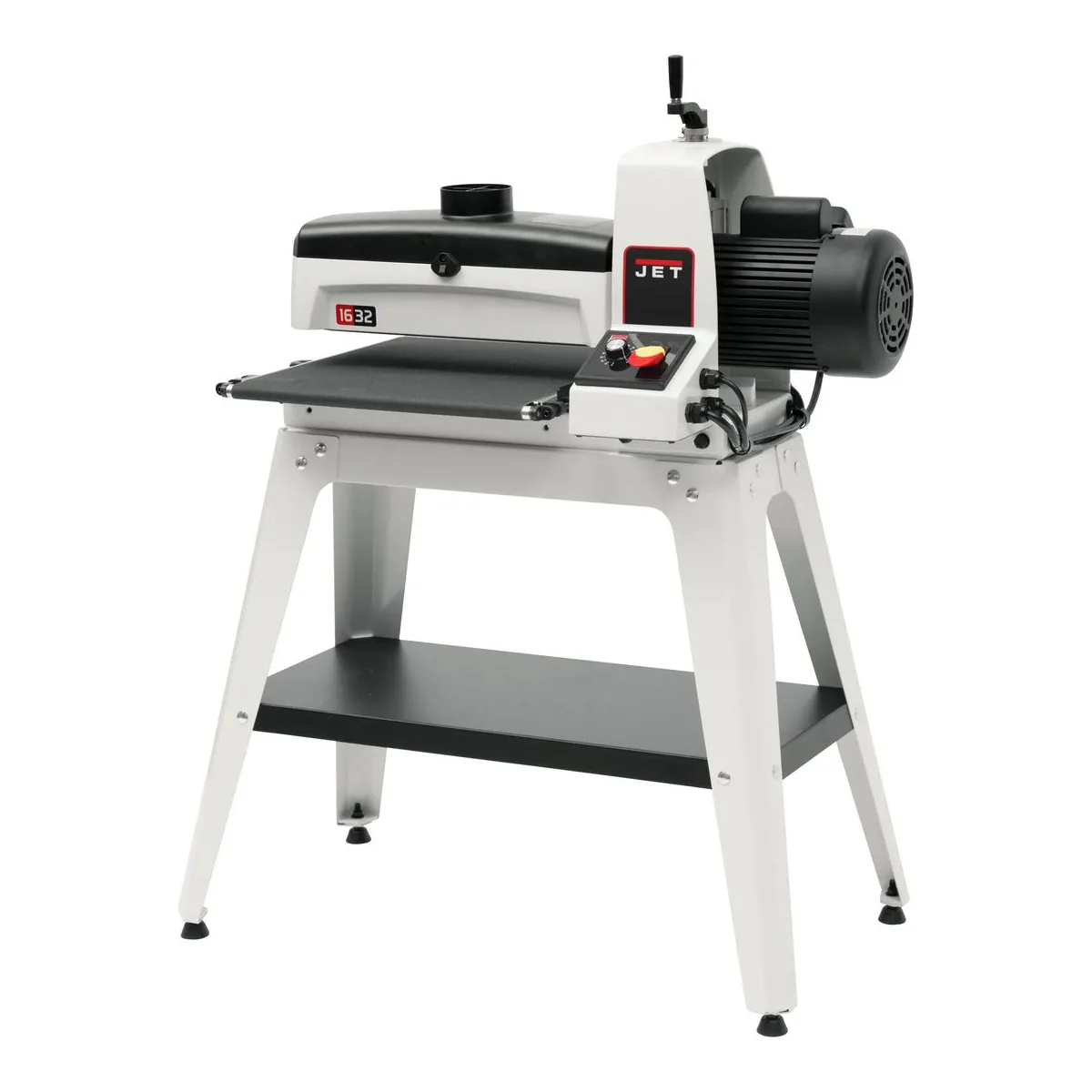
JET JWDS-1632
Right when the widest board you sand in a single pass is 16 inches or less, with a 32 inch ceiling for the odd wide piece run in two passes. The narrowest of these three, on a dedicated 20 amp, 115 volt circuit, for a shop that does not need a 25 inch bed.
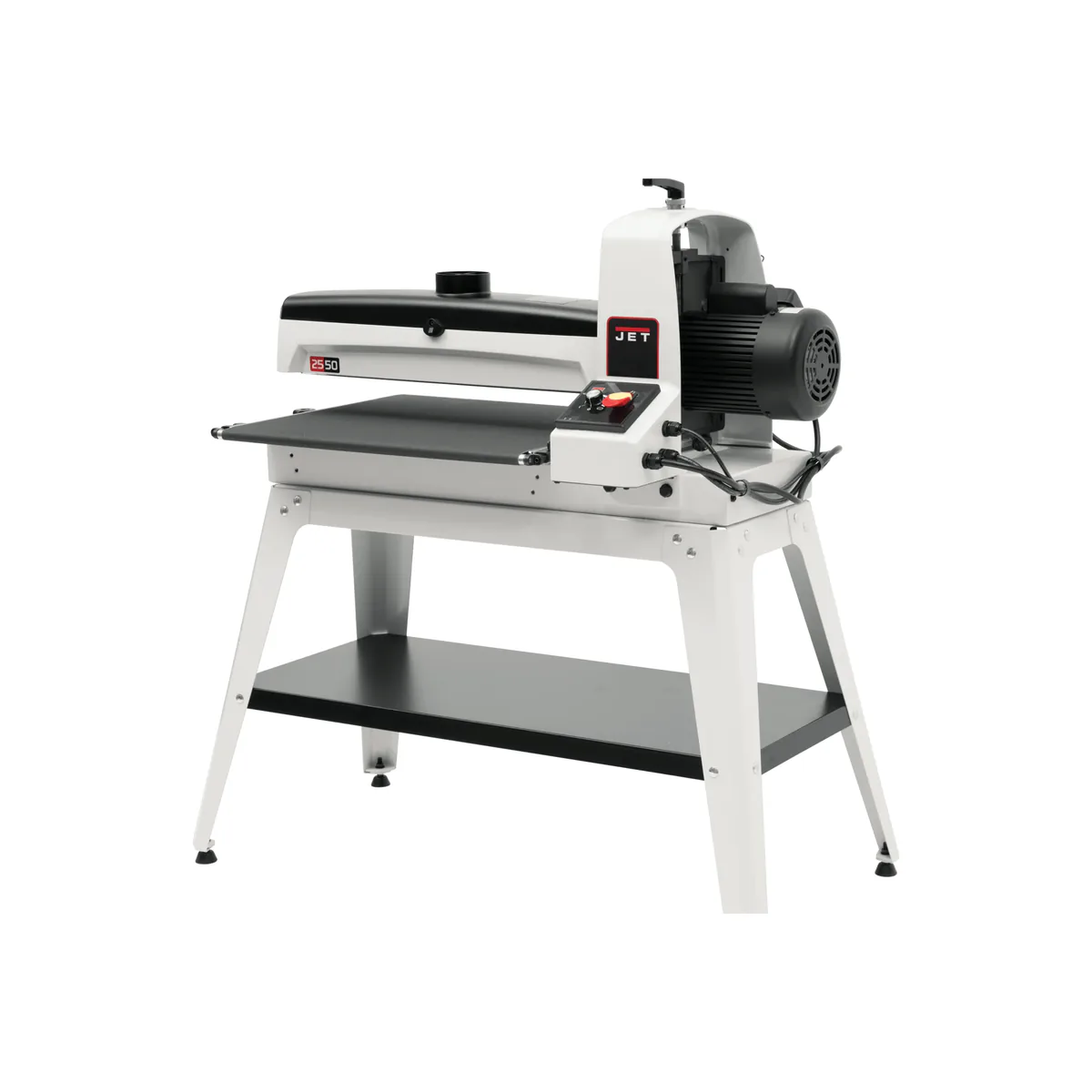
JET JWDS-2550
Right when you want 25 inches in a single pass, and this is also the machine here for a board over 25 inches: the open-end design reaches a 50 inch ceiling by turning the board and running it through a second time, on 115 volt.
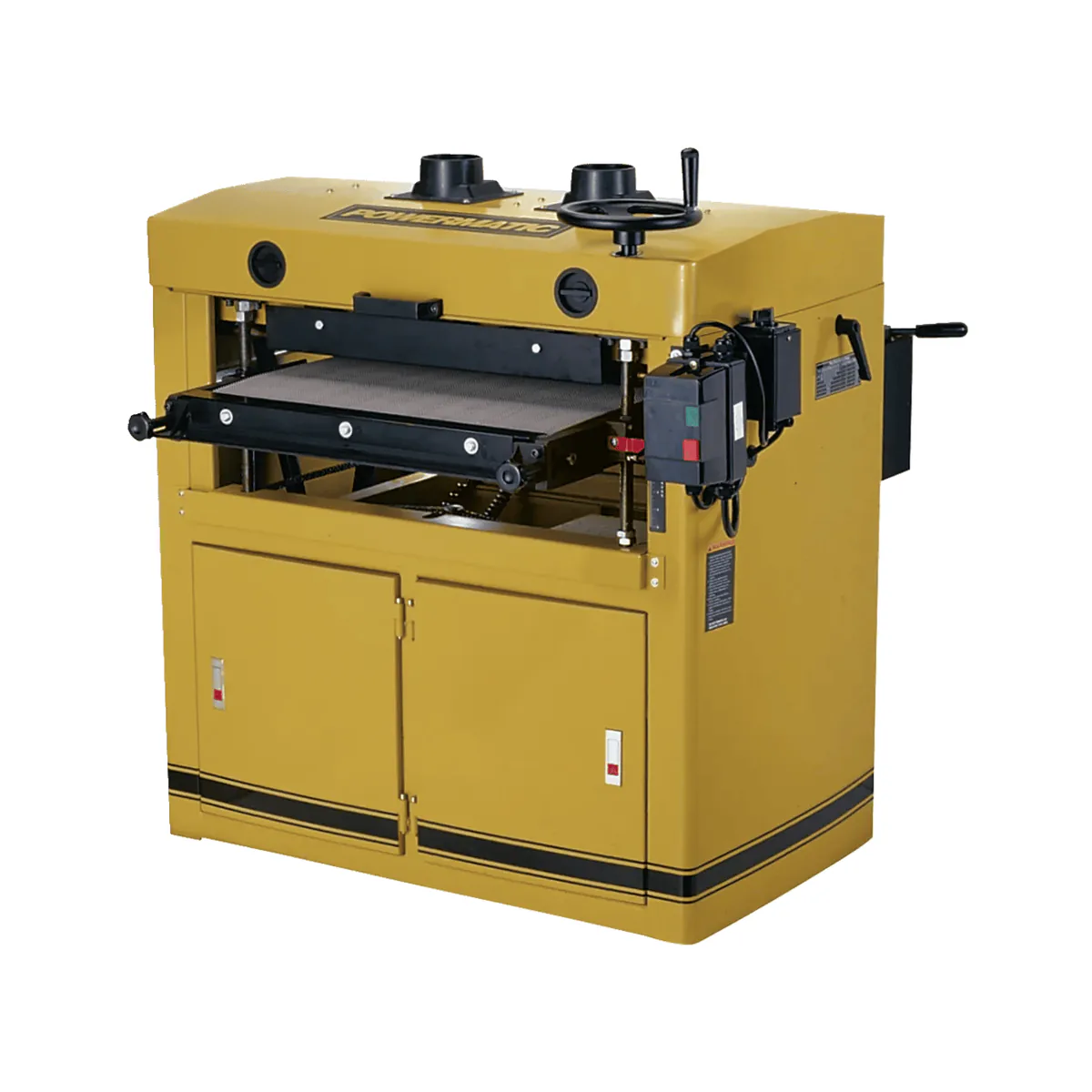
Powermatic DDS-225
Right when you want two grits on the board in one pass, or you sand stock over 4 inches thick, which it takes to 5.25. Its width is the same 25 inches the JWDS-2550 does in one pass, and 25 is its ceiling, and it asks for a 230 volt circuit, a 5 HP motor and 1200 CFM of collection.