SawStop Professional vs Industrial Saw: what 5 HP buys
Buy the Professional Cabinet Saw if a standard 230 volt outlet is what your shop already has and 3 HP has never been the ceiling. Step up to the Industrial only if you are running new wire anyway, because SawStop ships it with a disconnect switch and no plug at all, built for an electrician to land rather than a cord to plug in.
What decides it: Whether the extra motor is worth wiring a new circuit for.
We earn a commission on qualifying purchases through the links here, at no cost to you. It never decides what makes the list.
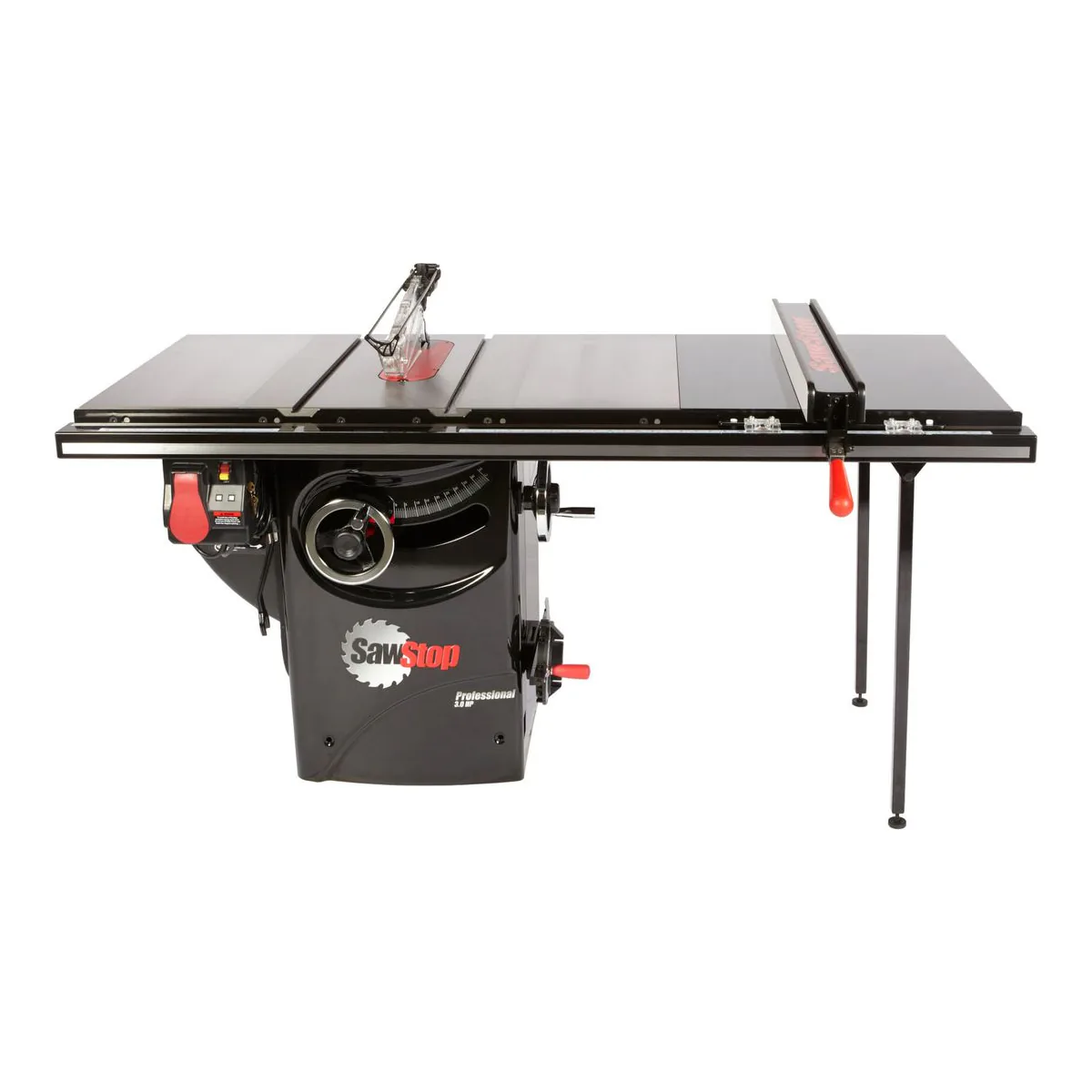
SawStop Professional 3HP
Pick this if a shop that already runs 230 volt single phase power and has never wanted for torque, since the blade, arbor, dado capacity and dust port are identical to the saw one rung above it.
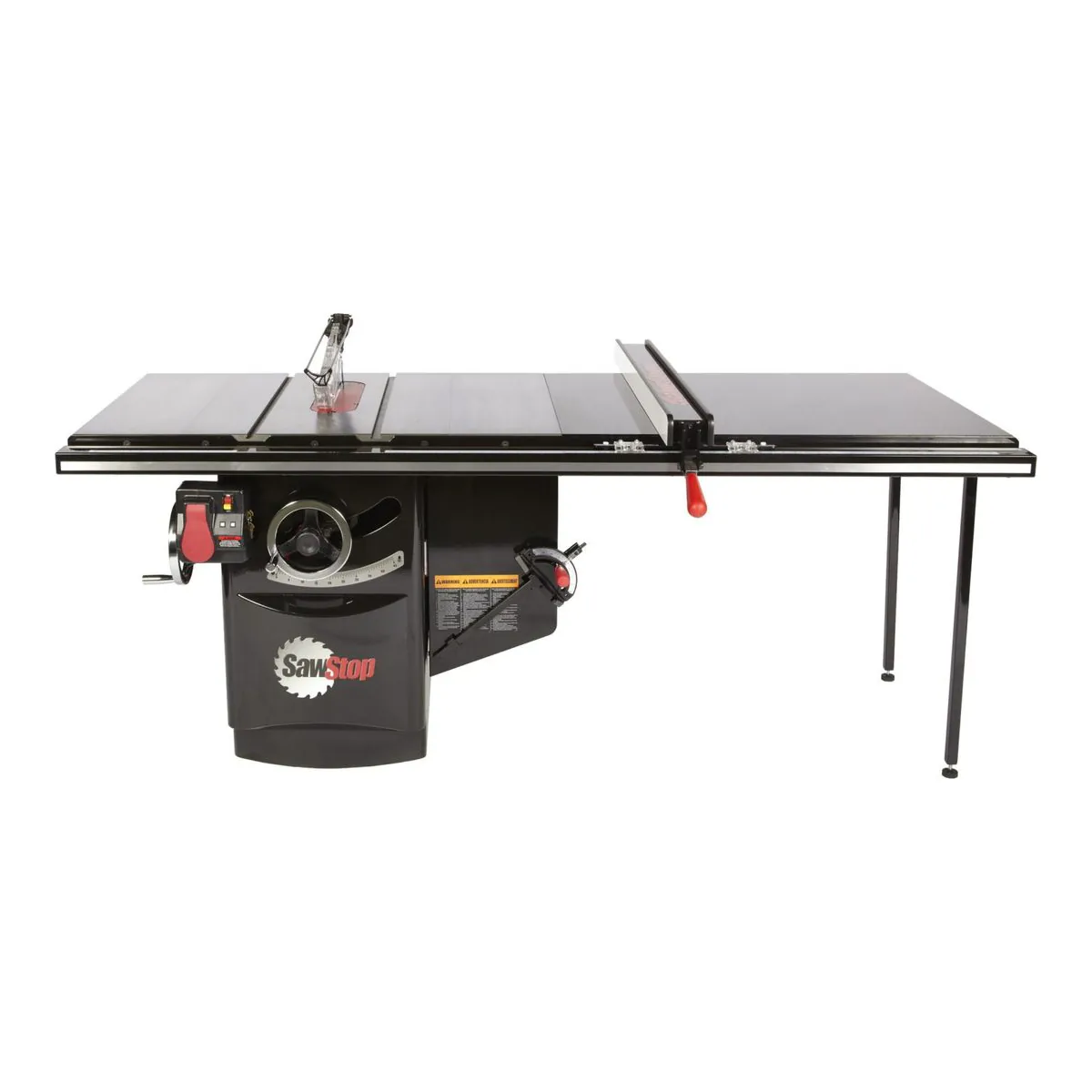
SawStop Industrial 5HP
Pick this if a shop willing to run a dedicated circuit for a saw with no cord to plug it into, where the extra table depth and the 19.7 amp motor justify the electrician's visit.
| SawStop Professional 3HP | SawStop Industrial 5HP | |
|---|---|---|
| Rip capacity right of blade | 52 in | 52-1/2 in |
| Motor (hp, volts, amps) | 3 HP, 208-240V | 5 HP, 230V, 1ph |
| Depth of cut at 90 and 45 degrees | 3-1/8 in at 0 | 3-1/8 in at 0 |
| Blade diameter and arbor | 10 in, 5/8 arbor | 10 in, 5/8 arbor |
| Fence type and travel | T-Glide Advance, 52 in | T-Glide Advance, 52 in |
| Dust port diameter | 4 in | 4 in |
| Riving knife, guard and brake | Flesh-detecting brake, riving knife, guard and pawls | Flesh-detecting brake, riving knife, guard and pawls |
Both of these are 10 inch SawStop cabinet saws with a 5/8 inch arbor, a 2.3 mm riving knife, an 8 inch dado capacity and a single 4 inch dust port. Neither number changes between them. What changes is the motor behind the blade, the casting it sits in, and, more than either of those, how the saw expects to be wired into your shop at all.
SawStop Professional vs Industrial saw: the cut is identical
Rip capacity is effectively the same: 52 inches on the Professional's Advance T-Glide fence against 52-1/2 inches on the Industrial's. Depth of cut matches exactly, 3-1/8 inches with the blade vertical and 2-1/4 at 45 degrees, on both machines. The riving knife is the identical 0.090 inch (2.3 mm) part number range, and the flesh-detecting brake system stops the blade on skin contact the same way on both, because it is the same safety platform underneath two different cabinets.
One blade-side difference does show up in SawStop's own spec table: which blade ships in the box. A 40 tooth combination blade comes standard on the Professional. The Industrial ships a 60 tooth combination blade as standard, so the finer blade is the default and no add-on, a small tell for who each saw is built to sell to.
Basis: manufacturer specification tables for both saws.
What the extra two horsepower actually carries
Rated at 3 HP, the Professional's motor draws 13 amps at 208 to 240 volts. In this single phase 230 volt configuration, the Industrial's motor is 5 HP and draws 19.7 amps, close to 50 percent more current for close to 66 percent more horsepower. That amperage figure decides the circuit, not the name on the cabinet.
Bigger iron surrounds that motor too. SawStop's own table lists the Professional's cast iron table at 20 by 27 inches and the Industrial's at 24 by 30 inches, three inches deeper front to back on top of four inches wider. The cabinet footprint grows from 19-3/8 inches square to 20 by 25 inches to carry it. All of that iron adds up on the scale even before a fence is bolted on: 335 lb for the bare Professional saw against 530 lb for the bare Industrial, 195 lb heavier for a saw that cuts to the identical depth.
Basis: manufacturer specification tables for both saws.
The plug that isn't there
Here is the difference the spec table does not print anywhere. The Professional's owner's manual gives its power connection its own section: a 9 foot cord terminating in a NEMA 6-15P plug, sized for a standard single phase 230 volt outlet. Read the Industrial's manual end to end, covering thirteen motor and voltage options from 3 HP single phase up to 7.5 HP three phase 480 volt, and the words "plug" and "power cord" do not appear once. What it documents instead is an electrical disconnect switch mounted on the cabinet, switched to ON to run the saw and locked OFF for service, which every one of those thirteen configurations shares.
Neither manual states in so many words that an electrician has to land the Industrial's wiring, and nothing here claims a rule that isn't written down. But a saw whose own manual never once shows a cord is designed to be wired in permanently, never plugged into a receptacle. That carries a real cost most Professional buyers do not pay: new 230 volt wire run to a disconnect box, with no existing outlet to fall back on.
Basis: manufacturer owner's manuals for both saws.
A shop wired for it against a shop that isn't
If your outbuilding or garage already carries a 230 volt circuit for something else, a welder, a compressor, a kiln, the Professional slots into it with a cord you already own. Nothing about the cut changes if you never touch the Industrial: same blade, same dado, same riving knife, same dust port. The SawStop PCS175 is a smaller 1.75 HP version of this same Professional cabinet. Look there if a rung below 3 HP is closer to what a one person shop actually needs.
Only where new wiring was happening anyway, a new shop build or a panel upgrade already planned, does the Industrial earn its place, because that is the only scenario where no plug in the box stops being a cost and starts being irrelevant. Its deeper table and finer stock blade are real, and neither is worth an unplanned electrician's invoice on its own.
Buying on horsepower alone and skipping both of these is how a shop ends up with a saw its outlets cannot feed. The full table saw shortlist covers every rung SawStop and its competitors sell at this shelf. It sizes each one to what a circuit can actually carry, whatever a spec sheet's biggest number says.