40 vs 48 amp EV charger: your car sets the ceiling
Buy 48 amps only if the car can accept 48 amps and the house can carry a 60 amp circuit. Otherwise 40 amps on a 50 amp circuit finishes the same overnight charge, and 32 amps is enough for a great many drivers on a smaller one. That last call is our judgment, and Qmerit prints no figure for it. The charger is almost never the limit that matters: Qmerit puts most modern EVs at between 32 and 48 amps of AC at 240 volts, roughly 7.7 to 11.5 kW, and says the vehicle onboard charger is what caps the rate. Read the car first, the panel second and the product page last.
48 amps is the size Qmerit fits most often, and more amps than many cars can draw. Across its residential jobs Qmerit reports 48 amp units at 70 percent against 21 percent at 40 amps and 7 percent at 32. Emporia, meanwhile, tells its own buyers that many popular EVs max out at 32 or 40 amps anyway, which means the hardwire speed advantage does not apply to their vehicle. Where both are true at once, the extra amps bought a larger breaker, thicker conductors and a permanent install to sit idle overnight.
What decides it, in order
Work down these. Each one narrows the answer, and the first is the one most buying guides skip.
What does your car accept on AC?
This is the ceiling, and everything downstream of it is spending. Qmerit states outright that the onboard charger ultimately limits how much power a car can accept, and the Department of Energy tells buyers to consult vehicle manufacturer guidance where possible and learn the specifications before purchasing equipment or electrical services.
- 32 amps or less
- A 32 amp unit covers that ceiling, and Qmerit puts 32 amps at about 7.7 kW. Anything larger buys a heavier circuit and delivers the same charge. No row in this chain is clearer.
- 40 amps
- A 40 amp charger on a 50 amp circuit is the exact match. It is also the most that circuit will carry continuously. Emporia states it for the NEMA 14-50 case, and ChargePoint caps both of its plug configurations at 40 amps. The install stays simple and nothing is wasted.
- 48 amps or more
- Now the 48 amp question is live, and it moves to the panel. It also forces the install method, because a 50 amp receptacle circuit stops below this.
How many miles do you add on a normal day?
Amps only matter against the hole they have to fill overnight. Qmerit publishes the conversion: 40 amps is about 9.6 kW and adds 20 to 30 miles an hour, and 48 amps is about 11.5 kW and adds 25 to 35. Both figures come with its note that most EVs achieve 3 to 4 miles per kWh, with larger trucks and SUVs possibly less efficient.
- Under 40 miles
- Qmerit puts a 32 amp unit at 18 to 25 miles an hour, so the charge fits in an evening and leaves the night spare. The size question has stopped mattering and the smart features are what you are actually shopping for.
- 40 to 100 miles
- A 40 amp charger covers this with the night to spare. Going to 48 shortens a charge that was already finished before anybody woke up.
- More than 100, or a truck sized battery
- Here the faster unit earns its circuit, because the tail of a large pack is where the extra 1.9 kW turns into a car that is fully ready in the morning. Without it, the car is nearly ready.
What circuit can the house give it?
NEC 625.42 designates electric vehicle charging as a continuous load, and a continuing education course on that section puts the consequence as 80 percent of the branch circuit rating not to be exceeded, which Qmerit states generally and Emporia states for the NEMA 14-50 case. So 40 amps needs a 50 amp circuit and 48 amps needs a 60. Emporia notes that most homes built after 1960 have 100 to 200 amp service and that a level 2 charger typically wants a dedicated 40 to 50 amp circuit out of it.
- Room for a 60 amp circuit
- The 48 amp unit is available to you, so the panel stops being the limit. The decision goes back to what the car accepts.
- Room for a 50 amp circuit
- Take the 40 amp unit and stop. Reaching 48 from here means a bigger circuit, and Emporia puts the gap between 40 and 48 amps, for many EVs, at the difference between a 6-hour charge and a 7.5-hour charge. That is what the upgrade would be buying. Load management is the other route out and it works by holding the amps down, so it does not buy that.
- Nothing spare at all
- Load management is the documented alternative, written into the code itself. NEC 625.42(A) lets an energy management system set the maximum equipment load on a service and feeder. The 2023 edition gave that its own subsection, and the 2020 text already permitted it. Qmerit says a load calculation or smart load management often replaces a panel upgrade.
Can the unit be turned down after it is on the wall?
An adjustable charger separates what you buy from what you draw, and the code contemplates it directly. NEC 625.42(B), a 2023 subsection out of language the 2020 text already carried for fixed in place equipment only, permits EVSE with restricted access to an ampere adjusting means and requires that where an adjustment affects the rating label, the adjusted rating appear on it.
- Yes, it is settable
- Buy the larger unit and have it commissioned at the current the circuit and the car support. Emporia lists its charge rate as settable in single amp increments from 6 up to 48 on a hardwired install, so one unit commissioned at 32 amps today can be turned up when the circuit is rebuilt.
- No, it is fixed
- Then its rating is fixed for the life of the install, and the sizing above is final.
Seven in ten residential installs by Qmerit, which calls itself North America's leading EV charger installation provider, are 48 amp units. Emporia tells its own buyers that many popular EVs max out at 32 or 40 amps anyway.
Most of the decision sits in the gap between those two sentences.
Choosing between a 40 vs 48 amp EV charger reads like a speed decision and is really three of them stacked: what the car will accept, what the panel will give up, and how much of the night you actually have. Only the first is fixed. It is also the one nobody checks before adding a charger to a cart, and it takes two minutes.
How many amps can your car actually take?
Whatever its onboard charger is built for. That figure lives in the owner's manual. The wall never shows it. Qmerit, the installation network behind more than 770,000 charging stations, puts the range at 32 to 48 amps of AC power at 240 volts, roughly 7.7 to 11.5 kW, and states the rule that governs everything below: the vehicle onboard charger ultimately limits how much power it can accept. A charger cannot push current a car declines to take.
Emporia sends buyers to that manual too, and adds the finding that makes this whole comparison smaller than it looks: many popular EVs max out at 32 or 40 amps anyway, which means the hardwire speed advantage does not apply to their vehicle. The Department of Energy gives the same instruction from the other direction and tells owners to consult vehicle manufacturer guidance where possible and learn the specifications before buying equipment or electrical services.
Do that one lookup before anything else.
What 40 vs 48 amp EV charger really trades
Qmerit publishes the conversion, so the trade is arithmetic. A 40 amp charger delivers about 9.6 kW and adds 20 to 30 miles of range an hour. A 48 amp charger delivers about 11.5 kW and adds 25 to 35, on their note that most EVs achieve 3 to 4 miles per kWh, larger trucks and SUVs possibly less. The whole case for the larger unit is 1.9 kW.
Emporia works the same sum on its help page and lands somewhere useful: an 80 kWh battery taken to 80 percent at 40 amps needs roughly 6.6 hours. A large pack, nearly empty, finished before anyone is awake. The 7.5-hour charge in the FAQ below is a different scenario: Emporia's own framing across many EVs, not one 80 kWh pack taken to 80 percent, so the two figures are not meant to reconcile. Faster is better on a truck battery that lands home close to empty most nights. It is invisible on a commuter car that arrives with two thirds of its range still in it.
The circuit is the difference, not the charger
Here is where the amps actually cost something. NEC 625.42 designates electric vehicle charging as a continuous load, and a continuing education course on that section puts the consequence as 80 percent of the branch circuit rating not to be exceeded. Qmerit states the same rule generally. Emporia's help page spells out the common case, that NEMA 14-50 circuits are rated for 50 amps but must be derated to 80 percent for continuous loads, limiting the output to 40 amps.
That sets the ladder. A 32 amp unit wants a 40 amp circuit, a 40 amp unit wants 50, and a 48 amp unit wants 60. Emporia lists that last pairing for its own hardwired install. The same step forces the install method too, because under that rule a NEMA 14-50 on a 50 amp circuit stops at 40 amps. Emporia states it that way, and ChargePoint builds it into both of its plug configurations. Choosing 48 amps therefore means choosing a hardwired install too, whether or not you meant to.
The bigger circuit also changes which ground fault rule can reach the install. NEC 210.8(F), new in the 2020 code, covers outdoor outlets for dwellings on single phase branch circuits at 150 volts to ground or less and 50 amperes or less. That source is explicit that an outlet includes a hardwired connection and not only a receptacle. So an outdoor hardwired unit on a 50 amp circuit sits inside it, and a 48 amp unit on the 60 amp circuit Emporia pairs it with sits above the ampere limit. Reading that section as reaching a charger is our inference; no code or manufacturer source prints it. Two members of a Tesla Motors Club thread on cheap outlets get to the same place, and a third says flatly that no ground fault rule reaches a hardwired unit indoors or out, so treat it as contested.
None of which exempts the plug in path, at any amperage. NEC 625.54 puts ground fault protection on a receptacle installed for EV charging wherever the receptacle sits, indoors included, which Leviton reprints with permission from NFPA. So the 40 amp plug in default takes that breaker in a garage the same as on a wall outside. A hardwired 40 amp unit has no receptacle for 625.54 to attach to, though that alone does not clear it of 210.8(F) above. TIA 17-2, the tentative interim amendment that introduced 625.54 against the 2017 code, scoped it to single phase receptacles at 150 volts to ground or less and 50 amperes or less. The 2020 text carries no such scope. We read that off the two documents side by side; neither one prints it. The 40 amp default comes out the same, because a 40 amp charger on a 50 amp circuit sits inside the 2017 band anyway. Adoption runs state by state, so an older jurisdiction may require none of it. Ask the electrician pulling the permit.
Then the panel has to have it. Emporia notes that most homes built after 1960 carry 100 to 200 amp service and that a level 2 charger typically wants a dedicated 40 to 50 amp circuit from it. On an older board, that bites. When there is nothing spare, load management is the documented answer: NEC 625.42(A) lets an energy management system set the maximum equipment load on a service and feeder, a subsection the 2023 edition added out of language the 2020 text already carried. Qmerit says a load calculation or smart load management often removes the need for a panel upgrade entirely. Sizing any of this is a licensed electrician's job, and permits may be required by the local building authority.
Which one to buy
Buy 40 amps. It is the default for a car that accepts 40, a house with a 50 amp circuit to spare, and a commute that ends with range left over. A 32 amp EV charger is the right answer more often than it gets picked, and Qmerit's table runs lower still, to 24 amps and even 16, so level 2 charger amperage has more rungs than the shelf suggests.
Buy 48 amps when three things line up: the car accepts it, the panel carries a 60 amp circuit, and the battery is big enough that the difference matters. Those three conditions make a narrower set than Qmerit's 70 percent of installs implies. Both ceilings sit on the level 2 charger shortlist, where the plug picks stop at 40 amps and the hardwired ones reach 48 or 50.
Know the escape hatch before you settle what size EV charger to order. NEC 625.42(B) permits equipment with restricted access to an ampere adjusting means, so an adjustable unit separates what you own from what it draws. The 2023 edition gave that its own subsection, and the 2020 text already permitted it for equipment fixed in place, a restriction the 2023 revision deleted. Emporia lists its charge rate as settable in single amp increments from 6 up to 48 on a hardwired install. Buy the larger unit, have it commissioned at the current the circuit and the car support, and the sizing stops being permanent. The permission turns on access to the adjustment being restricted, not on an app slider, and the electrician makes that call.
The same reasoning makes the connector question smaller than it looks. It is also why what this page had to clear is a list of documents and not a house style. The rest of the board gets read the same way.
Questions people actually ask
- Is a 48 amp EV charger worth it over 40?
- Only when the car can accept 48 amps and the panel can carry a 60 amp circuit, because the gap between the two is smaller than the install difference. Qmerit puts 40 amps at about 9.6 kW and 48 amps at about 11.5 kW, a difference of 1.9 kW, and Emporia frames what that buys, for many EVs, as the difference between a 6-hour charge and a 7.5-hour charge. Trimming that off a charge which already finishes before breakfast is not worth rebuilding a circuit for. It earns its keep when a large pack is close to empty most nights.
- Can I put a 48 amp charger on a 50 amp circuit?
- No. NEC 625.42 makes electric vehicle charging a continuous load. Emporia states the consequence for the common case: NEMA 14-50 circuits are rated for 50 amps but must be derated to 80 percent for continuous loads, which limits the charging output to 40 amps. A 48 amp unit needs a 60 amp circuit for 48 amps of output, and Emporia lists that pairing for its own hardwired install. What a 50 amp circuit can take is the same unit turned down. This is our reading across two documents, and neither one prints it as a sentence. NEC 625.42(B), a 2023 subsection out of language the 2020 text already carried, permits a rating equal to the adjusted current setting where access to the adjusting means is restricted. Emporia's charge rate is settable from 6 up to 48 amps on a hardwired install. Put that one to the electrician, since a product page cannot settle it. Sizing the circuit is a licensed electrician's job, and the Department of Energy notes that permits may be required by the local building authority.
- What size EV charger do most homes install?
- Nobody publishes a market figure, so the closest answer is one installer's own book of work. Across its residential jobs Qmerit reports 70 percent at 48 amps, 21 percent at 40 and 7 percent at 32, from a network that has installed more than 770,000 charging stations in total. Its own guidance is narrower than that headline: for most households a 40 or 48 amp level 2 charger is the balance of performance and cost, and higher units help only if the vehicle can accept the power and the electrical system can support it.
What that lands on
Machines that satisfy the chain above. The condition is on each one, because a machine that is right for one answer is wrong for another.
We earn a commission on qualifying purchases through the links here, at no cost to you. It never decides what makes the list.
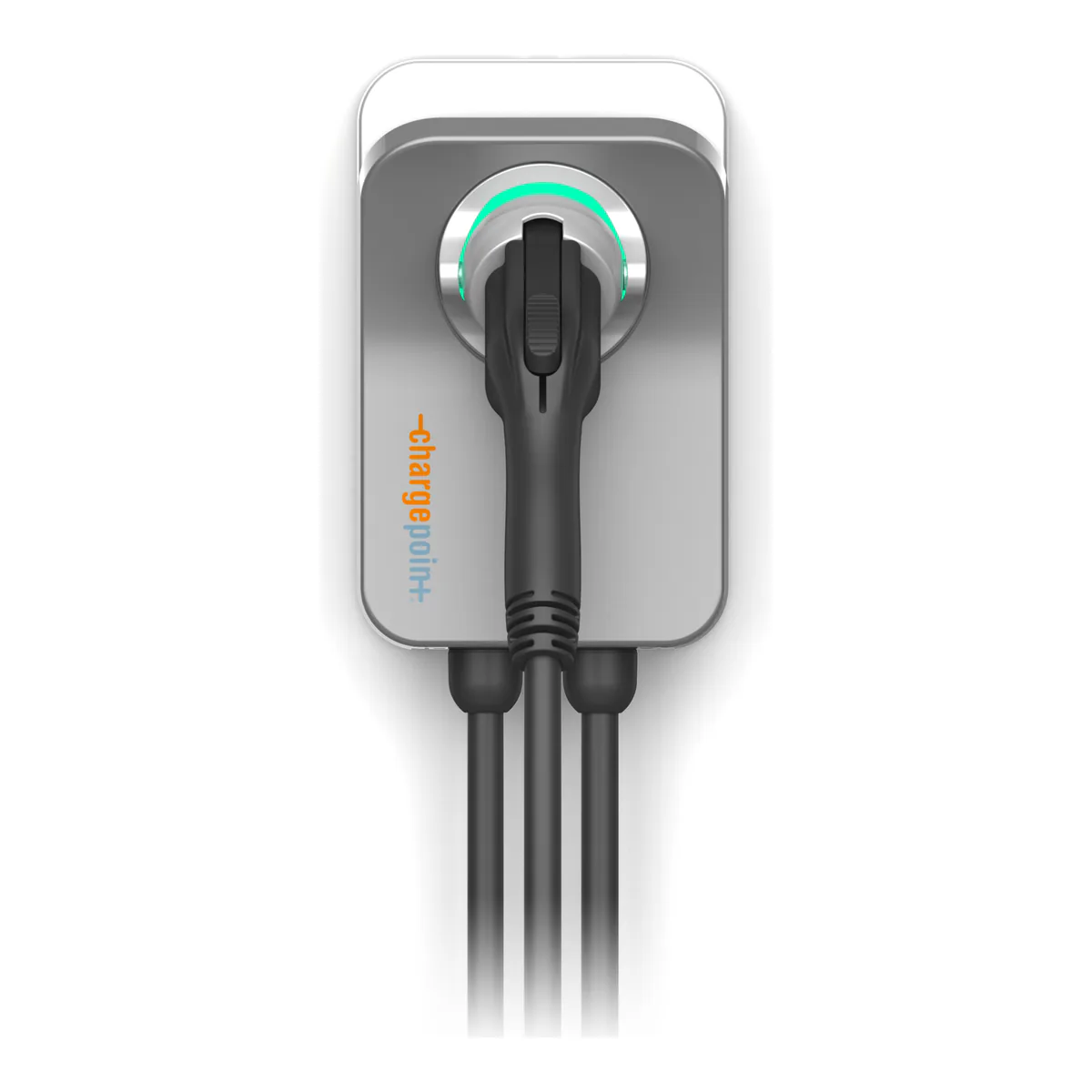
ChargePoint Home Flex
Right when the car accepts 48 amps and the house can carry a 60 amp circuit. Hardwired at up to 50 amps, this is the fast end, and it earns the heavier circuit only if the car can take it.

Emporia Level 2 EV Charger
Right when you are sizing to the car instead of the shelf. Qmerit puts most EVs at 32 to 48 amps and says the onboard charger caps the rate, so a 48 amp unit is headroom for a car that can use it and no faster for the many that top out at 40.