JET Dust Collectors Compared (JCDC-2, DC-1200VX-CK1, DC-1200VX-CK3, JCDC-3)
Most small shops want the JCDC-2: a 2 HP cyclone with 1 micron, MERV 13 filtration dropping chips into a drum, on a standard 230 volt single phase circuit. The DC-1200VX-CK1 trades that for a higher claimed 1200 CFM at the same 2 HP, through a coarser 2 micron canister filter into a cloth bag, and its CK3 sibling needs three phase power almost no small shop already has. Step up to the 3 HP JCDC-3 only once one collector is feeding more than one machine at a time.
We earn a commission on qualifying purchases through the links here, at no cost to you. It never decides what makes the list.
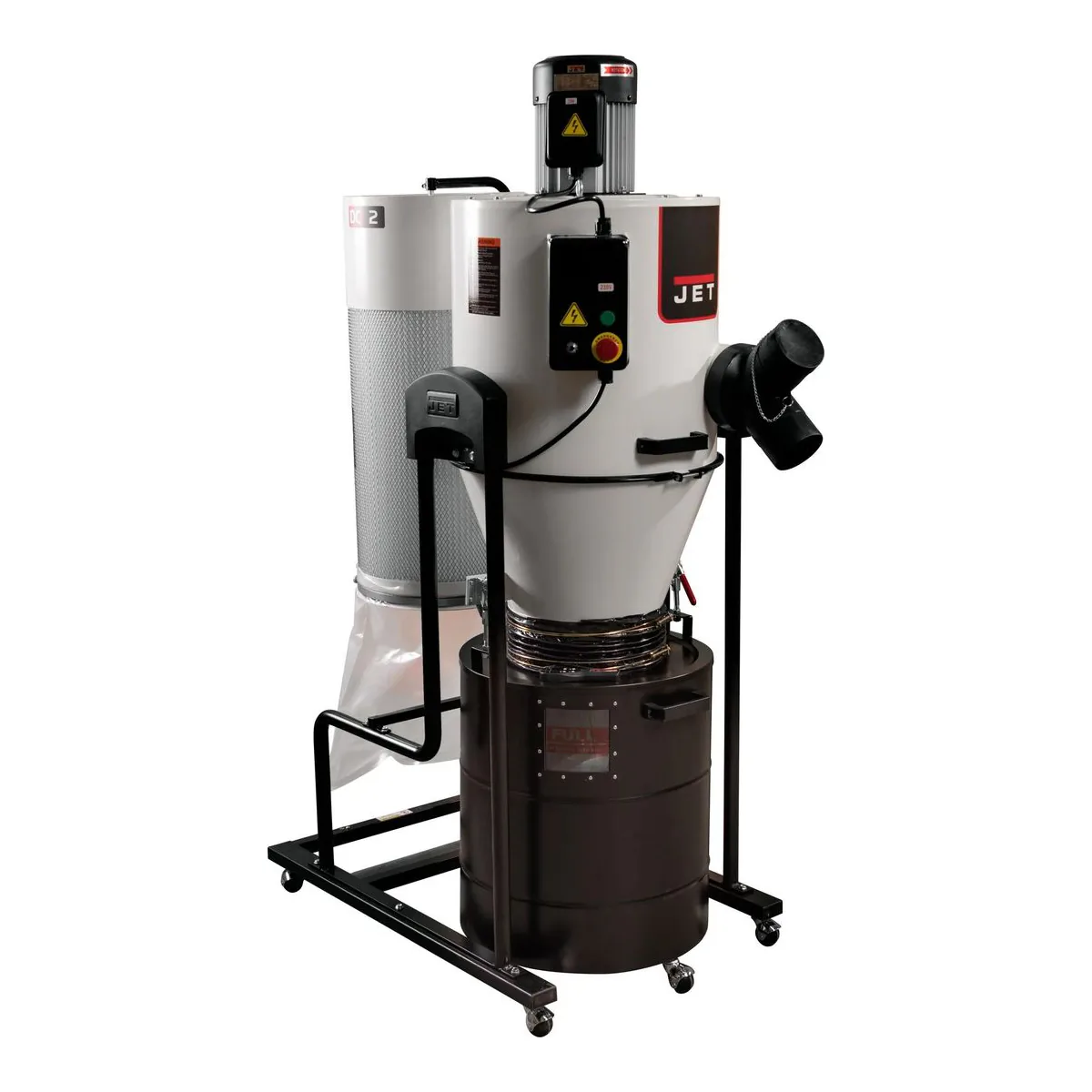
JET JCDC-2
Stop here if a single 2 HP machine's worth of shop that wants the finer 1 micron, MERV 13 filtration and a drum rather than a bag.
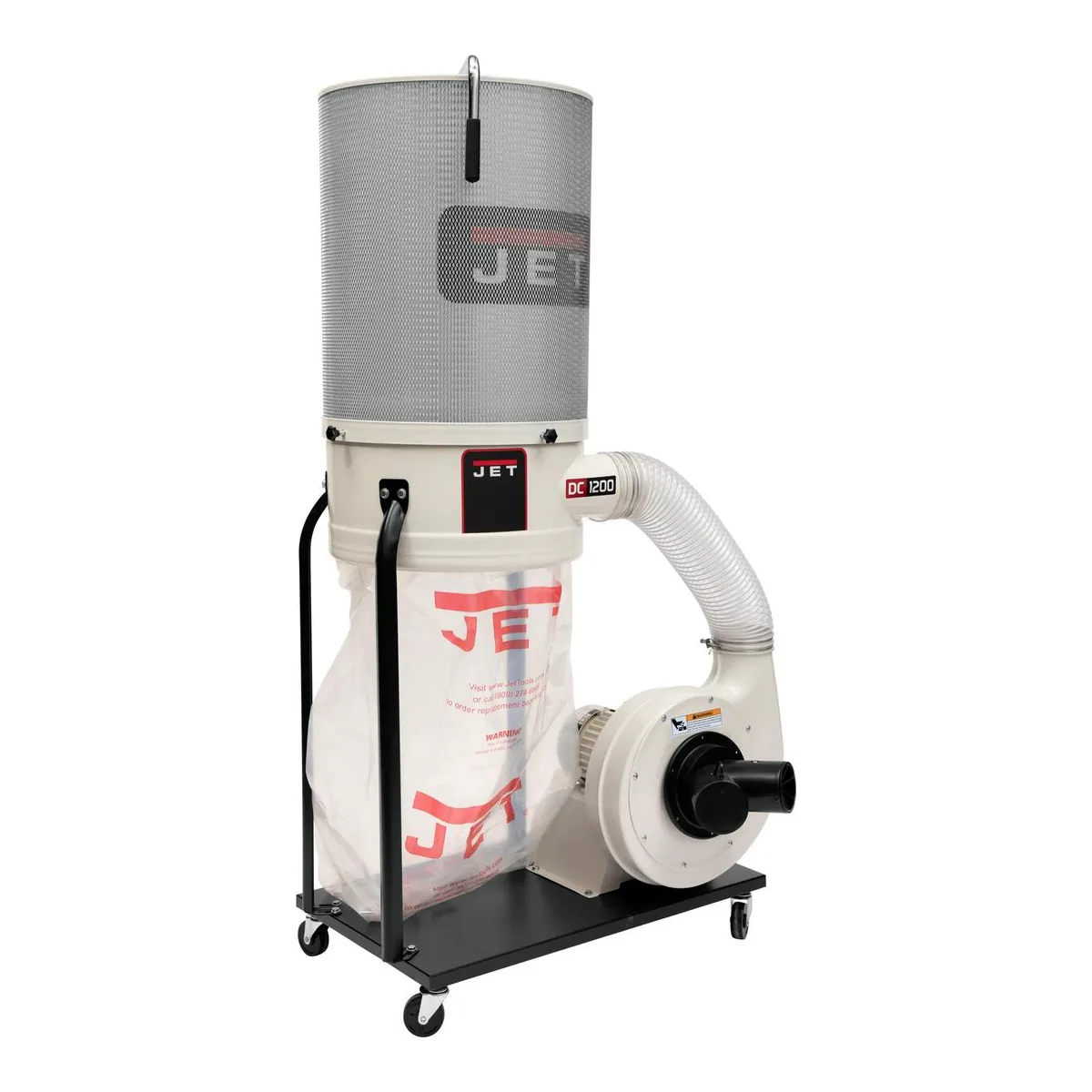
JET DC-1200VX-CK1
Stop here if a shop that wants the DC-1200VX's higher claimed CFM at the same 2 HP and standard single phase power, and does not mind the coarser filter or emptying a bag instead of a drum.
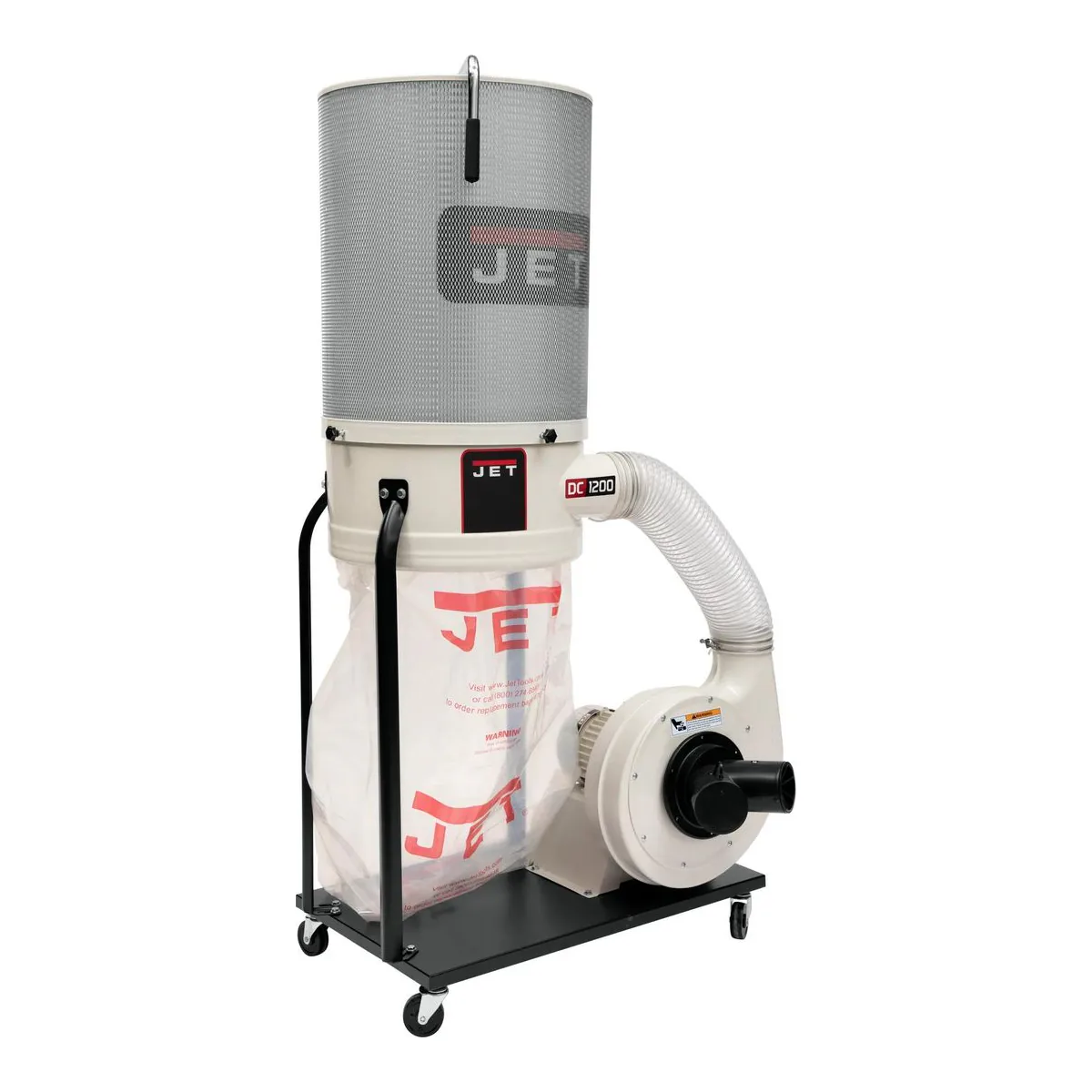
JET DC-1200VX-CK3
Stop here if the same shop as the CK1, but one already wired for 230/460 volt three phase power rather than standard single phase.
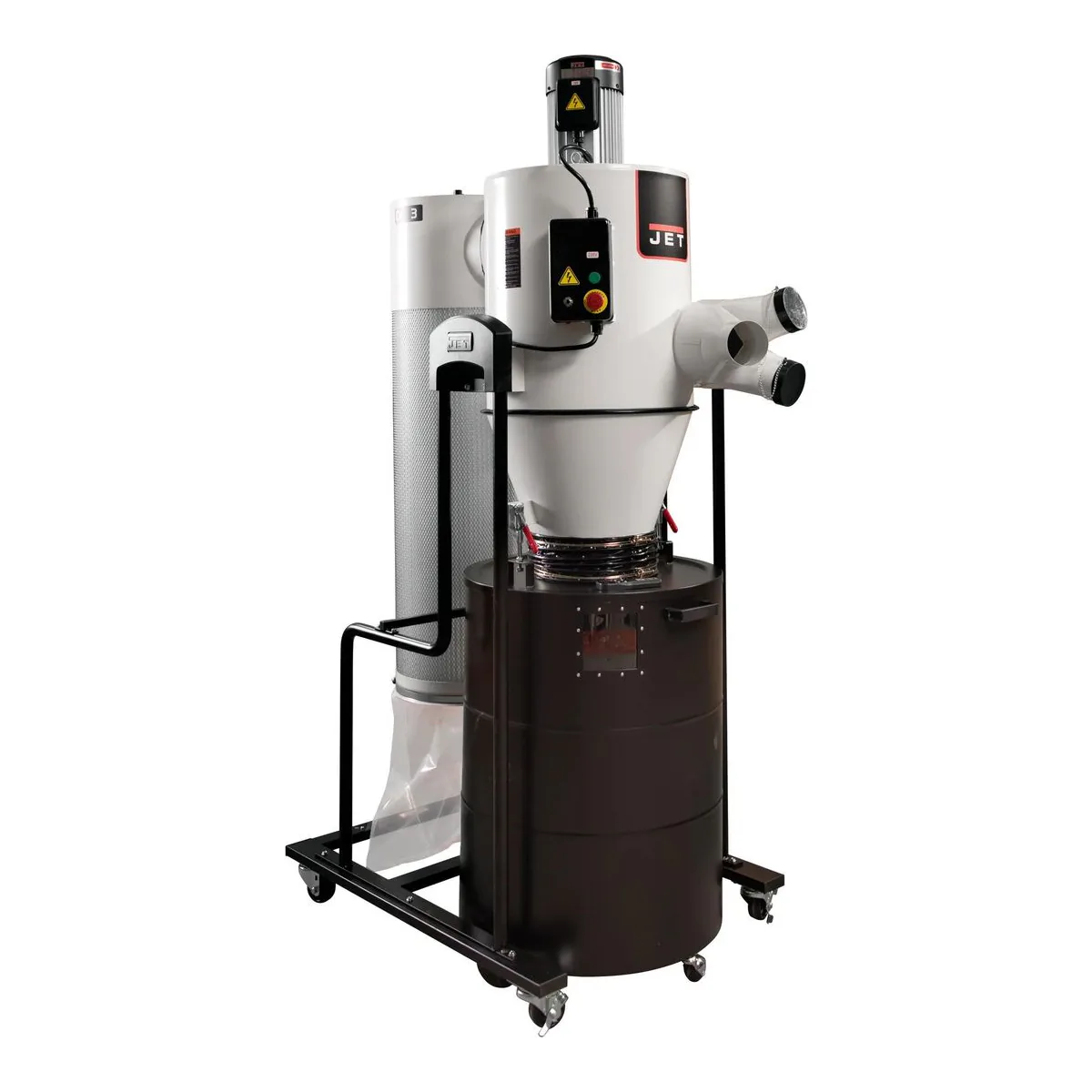
JET JCDC-3
Stop here if a shop feeding more than one machine off the same collector, or one that has already outgrown a 2 HP cyclone's airflow.
| Style | Airflow | Filtration | Motor | Inlet | Collection | Net weight | |
|---|---|---|---|---|---|---|---|
| JET JCDC-2 | Cyclone | 938 CFM filtered, 1538 CFM max | 1 micron, MERV 13 | 2 HP, 230V, 1 Ph, 9 A | 4 or 6 in | Drum, capacity not stated | 207 lb |
| JET DC-1200VX-CK1 | Canister | 1200 CFM | 2 micron canister | 2 HP, 230V, 1 Ph, 6 A | 4 or 6 in | 5.3 cu ft cloth bag | 170 lb |
| JET DC-1200VX-CK3 | Canister | 1200 CFM | 2 micron canister | 2 HP, 230/460V, 3 Ph, 6 A | 4 or 6 in | 5.3 cu ft cloth bag | 170 lb |
| JET JCDC-3 | Cyclone | 1240 CFM filtered, 1963 CFM max | 1 micron, MERV 13 | 3 HP, 230V, 1 Ph, 13 A | 4 or 8 in | Drum, capacity not stated | 242 lb |
JET's dust collector lineup splits into two designs before it ever splits into sizes, and that split matters more than the horsepower number stamped on any of the four boxes. Shop for JET dust collectors on Amazon and the JCDC-2, the JCDC-3 and the two DC-1200VX variants all show up on the same shelf, and the listing titles do name the difference, cyclone against vortex cone canister, in words easy to skim past while chasing the CFM number.
Two of the four are what JET's own spec sheet calls a cyclone, and two are a canister collector. That one word sets where the chips go, how fine the filter is, and what you empty when it fills. Read this before picking one off our dust collector shortlist, because a CFM figure alone tells you less than the design behind it.
Which JET dust collectors are actually different
All four carry JET's own five year warranty, and all four accept either a single wide inlet or a manifold splitting it into narrower hoses, so flexibility at the port is not what separates them.
What separates them is the machine behind that port. JET's own spec sheet lists the JCDC-2 and JCDC-3 as a cyclone design, dropping chips and heavy dust into a drum, and it carries a 1 micron, MERV 13 rating on both without stating the drum's capacity. The DC-1200VX-CK1 and DC-1200VX-CK3 are listed as a canister design, built around a 5.3 cubic foot cloth bag in place of a drum, at a coarser 2 micron rating. Noise sits close across the family: the two cyclones are both rated at 76 dB, and JET rates the DC-1200VX pair at a 70 to 80 dB range with no distance stated for either.
What changes, rung by rung
Here is what actually changes at each step of the four, from the smallest cyclone to the largest.
JCDC-2: the 2 HP cyclone
A 2 HP cyclone moving 938 CFM of filtered air, 1538 CFM maximum, through a 1 micron, MERV 13 filter, on a 230 volt single phase motor drawing 9 amps. Chips and heavy dust drop into a drum before the air reaches the filter, and JET does not publish the drum's capacity.
DC-1200VX-CK1: a different design, same horsepower
The same 2 HP motor, but a different machine. JET's own spec sheet lists the DC-1200VX-CK1 as a canister collector, not a cyclone. It claims 1200 CFM against the JCDC-2's 938, through a coarser 2 micron filter into a 5.3 cubic foot cloth bag where the cyclones use a drum. Still a standard 230 volt single phase circuit, drawing 6 amps.
DC-1200VX-CK3: the same machine, a different electrical service
Identical to the CK1 in every spec that matters to the air moving through it: same 1200 CFM, same 2 micron filter, same 5.3 cubic foot bag. Only the motor's wiring differs, 230/460 volt three phase in place of single phase. That makes it a question for your electrician. It is no upgrade in capability.
JCDC-3: back to the cyclone, and up to 3 HP
JET's larger cyclone, moving 1240 CFM of filtered air, 1963 CFM maximum, through the same 1 micron, MERV 13 filter as the JCDC-2. It runs on 230 volt single phase power, drawing 13 amps against the JCDC-2's 9. The inlet grows too: a single 8 inch trunk or a manifold of three 4 inch hoses, up from the JCDC-2's single 6 inch trunk or a manifold of two. At 242 lb net it is the heaviest of the four, and at 88 inches tall it is also the tallest, against 72-1/4 inches for the JCDC-2 and 79 inches for either DC-1200VX. It is the rung our own JCDC-3 review covers in full.
Who should stop where
Filtration and collection method matter more here than airflow does. If fine dust matters to you, the two cyclones' 1 micron, MERV 13 filter beats the DC-1200VX pair's 2 micron canister regardless of the higher claimed CFM. JET does not publish the cyclones' drum capacity, so there is no clean comparison to the DC-1200VX pair's stated 5.3 cubic feet, only the filtration difference to weigh.
Most small shops should stop at the JCDC-2. Step up to the JCDC-3 only once a single 2 HP cyclone is actually feeding more than one machine, and reach for a DC-1200VX only when the higher claimed airflow matters more to you than the finer filter, checking first whether your shop has the single phase power the CK1 needs or the three phase power the CK3 demands instead. How to size a collector to your own ductwork and how to match its inlet to your tools' ports are both a better place to start than a model number.