ECOVACS GOAT A3000 LiDAR review vs the PRO
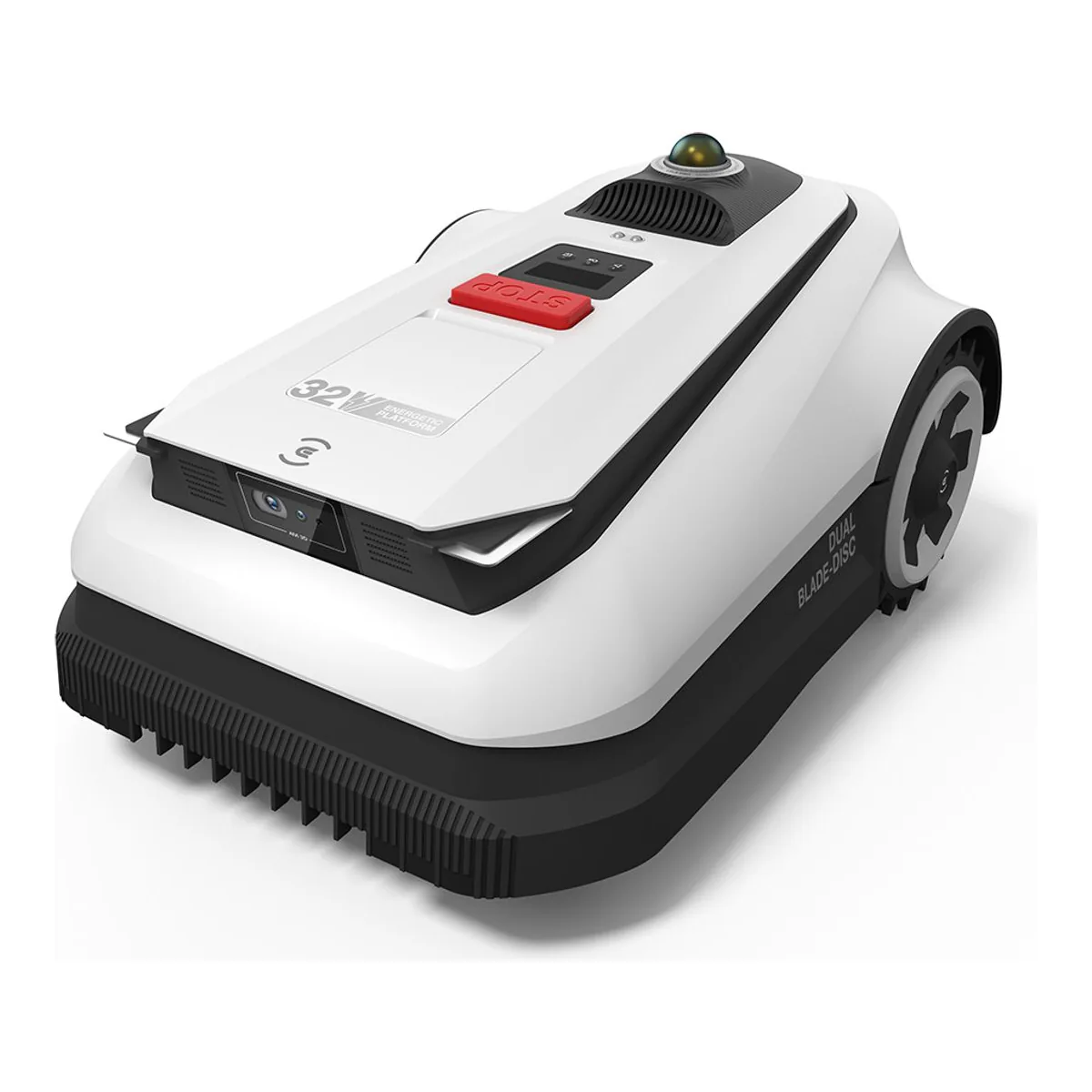
A wire-free LiDAR robot mower for a shaded 3/4 acre bordered by paving it can ride over, with a 45 minute recharge and a cut four owners praise, now sold out on ECOVACS's own store, which points to the LiDAR PRO. Skip it if your lawn meets a curb, soft soil, a bed that drops away or wet grass: 5 of the 9 owners we counted report it stuck or struggling at one of those, and it steers on two front casters.
- Rated for lawns up to 3/4 acre
- Wire-free dual LiDAR navigation, a 360 degree LiDAR on top plus a forward 3D ToF LiDAR and AI camera, with no RTK station
- 5Ah battery that charges in 45 minutes on 180W charging
- Dual blade discs with a 12.99 in cutting width
- TruEdge edge mowing as close as 2 in at an edge it cannot cross (ECOVACS figure), riding over passable edges
- Climbs slopes up to 50 percent (27 degrees)
We earn a commission on qualifying purchases through the links here, at no cost to you. It never decides what makes the list.
ECOVACS's own US store page for the ECOVACS GOAT A3000 LiDAR lists it as sold out and links to the A3000 LiDAR PRO, while Amazon still sells the original under two listings. Is it still the right mower for a 3/4 acre lawn under trees, or is the PRO the one to order?
Buy it if your lawn is shaded, broken up by beds and borders it can map, and ends at paving it can ride over. Two LiDAR sensors and a camera find their way with no wire and no RTK antenna, and the battery refills in 45 minutes. Skip it for a front yard with a street curb, soft ground or beds that drop away from the grass, because it drives its rear wheels and steers on two front casters, which three owners we counted blame when it sticks. For a yard like that, start with the all wheel drive picks on our robot mower shortlist.
The evidence is ECOVACS's spec table, the live listing, hands-on reviews from PCWorld and PCMag, a season of use from Tom's Guide, and 9 owners in one Reddit thread about this model, opened before the PRO existed (how we count).
Coverage: 3/4 acre across a day of charges
ECOVACS rates it for 3/4 acre, and its own lab figure is 5,382 square feet every two hours, including the trip home to recharge. A full 3/4 acre is about 12 hours of mowing and charging, PCMag's figure too, so the schedule spreads it across days.
The recharge is the standout: 45 minutes by ECOVACS's figure, on a 5Ah battery and a 180W charger, and one owner sees about 90 percent in that time. Runtime is murkier, because ECOVACS prints two figures, 118 minutes from full to 15 percent on its spec table and 75 minutes on its own Amazon comparison chart. Plan on 75. It squares with the lab rate: 75 minutes at 4,305 square feet an hour, plus a 45 minute charge, is that 5,382 square feet in two hours. One owner reports two and a half to three hours a charge; another found it drains fast.
PCMag's unit cut a 350 square foot yard in about nine minutes on its fast setting, where the Eufy E18 took 36.
Boundary method: dual LiDAR, no wire, no RTK
A spinning LiDAR on the roof and a 3D time-of-flight LiDAR in the nose do the positioning, with an AI camera beside it. Nothing gets buried and no antenna gets staked, and as a LiDAR robot mower it keeps working under trees and beside a house, where satellite positioning loses its fix. One owner swapped an A2500 RTK that got lost and drove over curbs for this one: "I can recommend this robo-mower. I couldn't before."
Mapping is quick and imperfect. PCWorld's unit automapped the level part of its yard faster than any mower the reviewer had tested, while PCMag's first map rounded off corners and left strips unmown, with no app tool to straighten an edge. Slopes and open borders need driving by hand over Bluetooth, which dropped dozens of times in PCWorld's half hour of manual mapping.
Max slope: 50 percent, steered by two casters
ECOVACS rates 50 percent (27 degrees). PCWorld lists slope and cliff detection issues among its cons, with poor navigation through narrow passages, so a steep yard is a risk on the reviewer's evidence alone. No owner in the thread mentions a slope.
Five of them report it stuck or struggling: three at an edge (two at a curb, one at a bed), one in soft soil, one on wet grass. Three of those five blame the front casters or wheels. One owner's casters sank into soft soil and small dips. Another says it can get stuck when its front wheels fall into a flower bed as it swivels to reverse. The worst case is a 6 inch street curb, where one owner lost count of the times it went halfway over, and the grinding wore the blade discs and screws until the last set came out with vise grips. A fifth, on wet grass, wished for all wheel drive.
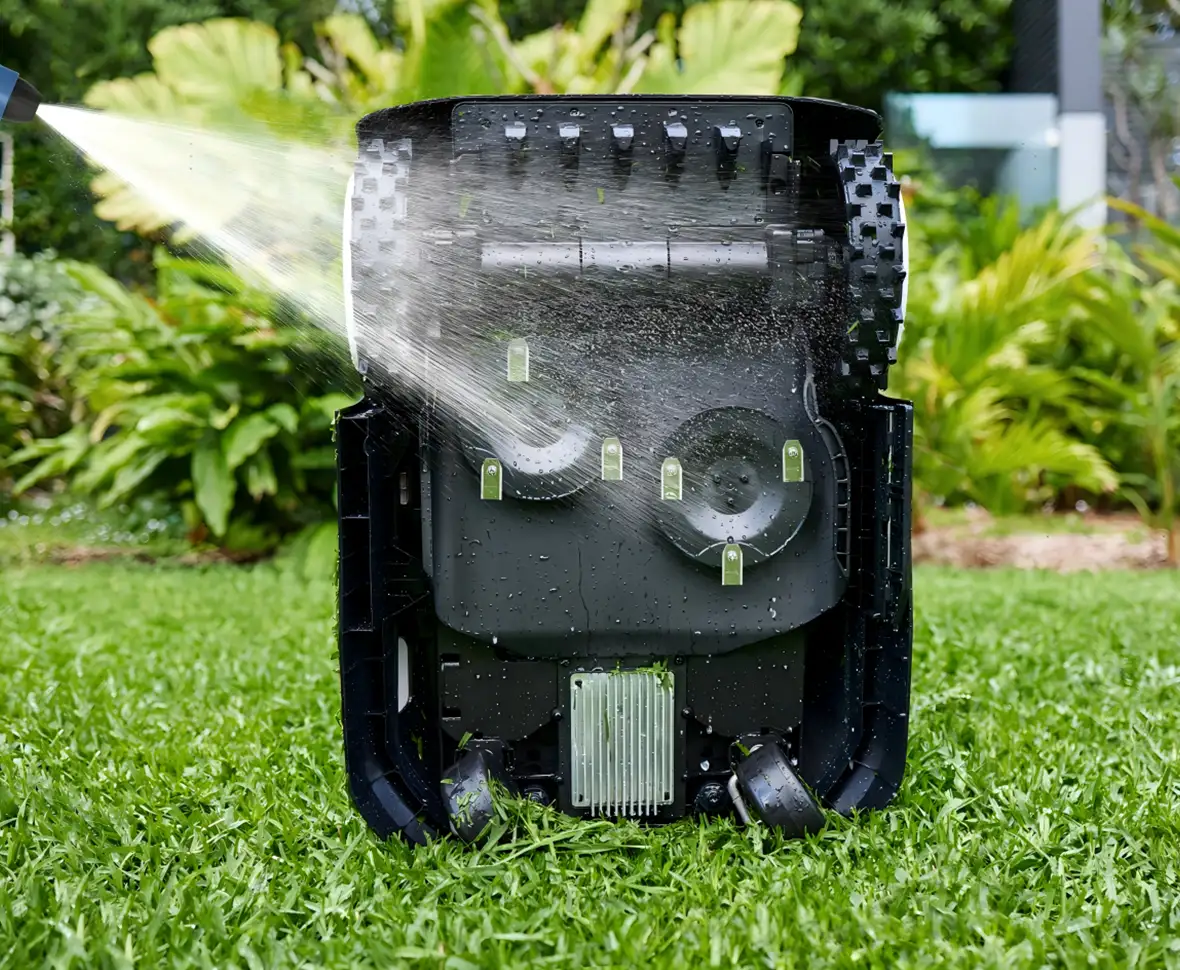
Owners worked around it: pull the boundary in from the curb and turn off edge mowing, change the boundary tolerance and remap, or flatten the soft ground. If your yard has that shape, our robot mower slope guide explains why a rating measured straight uphill says little about turning at an edge.
Cut height and GOAT A3000 blades
The deck adjusts from 1.2 to 3.6 inches in 1 centimeter steps, from the phone. Two discs with three blades each cut a 12.99 inch path at 3,000 rpm, and four owners in the thread praise the cut, one calling it fantastic. A fifth calls it only okay next to regular mower blades, and one of the fans sets the bar plainly: "dont expect the same fine cut as a mower with a mulching blade." Tom's Guide, mowing almost an acre of lumpy ground, found the job nearly perfect every time, though bumps read as tall grass; the mode for longer grass mitigated it, and the reviewer still had to free it now and then.
Blades are the consumable. Six ship fitted and a spare kit of 12 more is in the box. Tom's Guide says they break more often than the reviewer would like, PCMag saw corrosion on them within a couple of weeks, and ECOVACS sells a blade kit that lists the A3000 LiDAR.
Obstacle avoidance, and edges with no trimmer
ECOVACS claims more than 200 obstacle types. The owner with the curb says it rarely runs into obstacles and adds: "This unit always knows where it is and never gets lost or loses signal." Another found it avoided a lot, though it tried to climb the metal legs of a trampoline until they taped across them. The bigger flaw runs the other way, because it is cautious. The curb owner's mower will not cut under vines hanging two to three feet up, and a weed left to grow tall gets mowed around like a tree, so it keeps growing. A second owner says the same of one shoot of wheat grass at 8 inches.
The edges are where it differs from the PRO. TruEdge on this model is the blade riding over a passable border, a patio or a path, and stopping as close as 2 inches from a wall by ECOVACS's figure. PCMag's unit still rounded corners, sat about five inches off two edges, and could not get against a fence or wall, so expect to keep a string trimmer. Dusk mowing works on LiDAR alone; one owner found the edge pass waits for daylight, because the camera handles edges.
Multiple zones, the app and your data
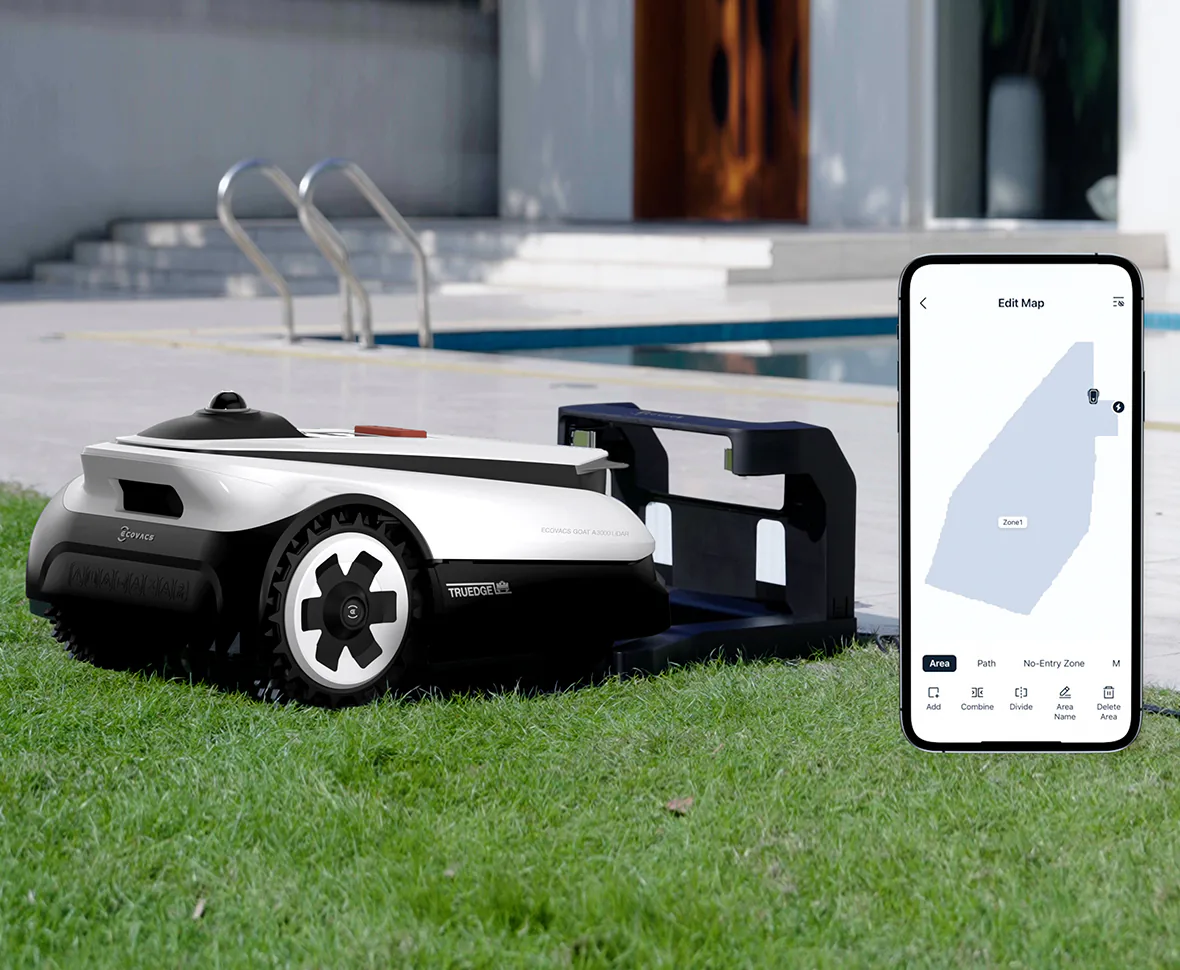
The app adds, merges, splits and deletes areas, draws no-go zones, and sets speed, cutting height and obstacle height per zone. PCWorld calls it outstanding; one owner found it hard to tell whether a setting had applied.
The setup tip to copy came from an owner on a second unit: map each patch of grass as its own area, join them with the "add path" tool, and stop trying to carve the house out as a no-go zone. They report no bad mow since. Two limits owners name: one map per mower, and no way to switch edge mowing off for a single zone.
It runs through the ECOVACS HOME app over Bluetooth and Wi-Fi, and an optional cellular module lists it as compatible. The app's international privacy policy says ECOVACS will not sell or loan your information without asking first, that it may share it with companies working on its behalf, and that your data may be processed and stored outside your country.
What breaks
Two of the 9 owners had a unit fail. One's LiDAR quit at about two months, and ECOVACS refunded it because no replacement was available. Another went through a lemon before a second unit worked. One owner worries the battery does not look user replaceable, and a reader who emailed and called ECOVACS support to ask had no answer after a week.
ECOVACS A3000 LiDAR vs PRO, and the LUBA 3
The PRO keeps a dual LiDAR layout and the 3/4 acre rating. Its 7.5Ah battery runs 160 minutes per charge on its spec table, where this model's table says 118 from full to 15 percent, and takes 70 minutes on 189W charging to refill against 45. It also adds a built-in string trimmer that cuts right to the wall. If walls and fences ring your lawn, the trimmer is the reason to step up. If the lawn ends at paving the blade rides over, this A3000 already does that edge. Our A2000 against A3000 LiDAR PRO comparison covers the PRO family.
If traction is your problem, the PRO lists the same front and driving wheel layout, so it will not solve it either. The Mammotion LUBA 3 AWD drives all four wheels, though our review carries its own warning about tight turns on soft ground. Keep the A3000 LiDAR for the shaded, bedded lawn it maps so well, and give it a clean first season: edge the borders before mapping, keep weeds short, and give every patch of grass its own area.
A closer look at the ECOVACS GOAT A3000 LiDAR
Made up your mind?