ECOVACS A2000 vs A3000: what the bigger battery buys
Buy the A3000 if the lawn is closer to 3/4 acre than 1/2, or if fewer stops to recharge matter more than the price gap. Buy the A2000 for anything at or under half an acre, since the two machines share the same navigation, trimmer, slope rating and cutting range, and the bigger battery is the main thing the A3000 is selling.
What decides it: Battery capacity and charge time, not navigation or the trimmer, which are the same on both.
We earn a commission on qualifying purchases through the links here, at no cost to you. It never decides what makes the list.
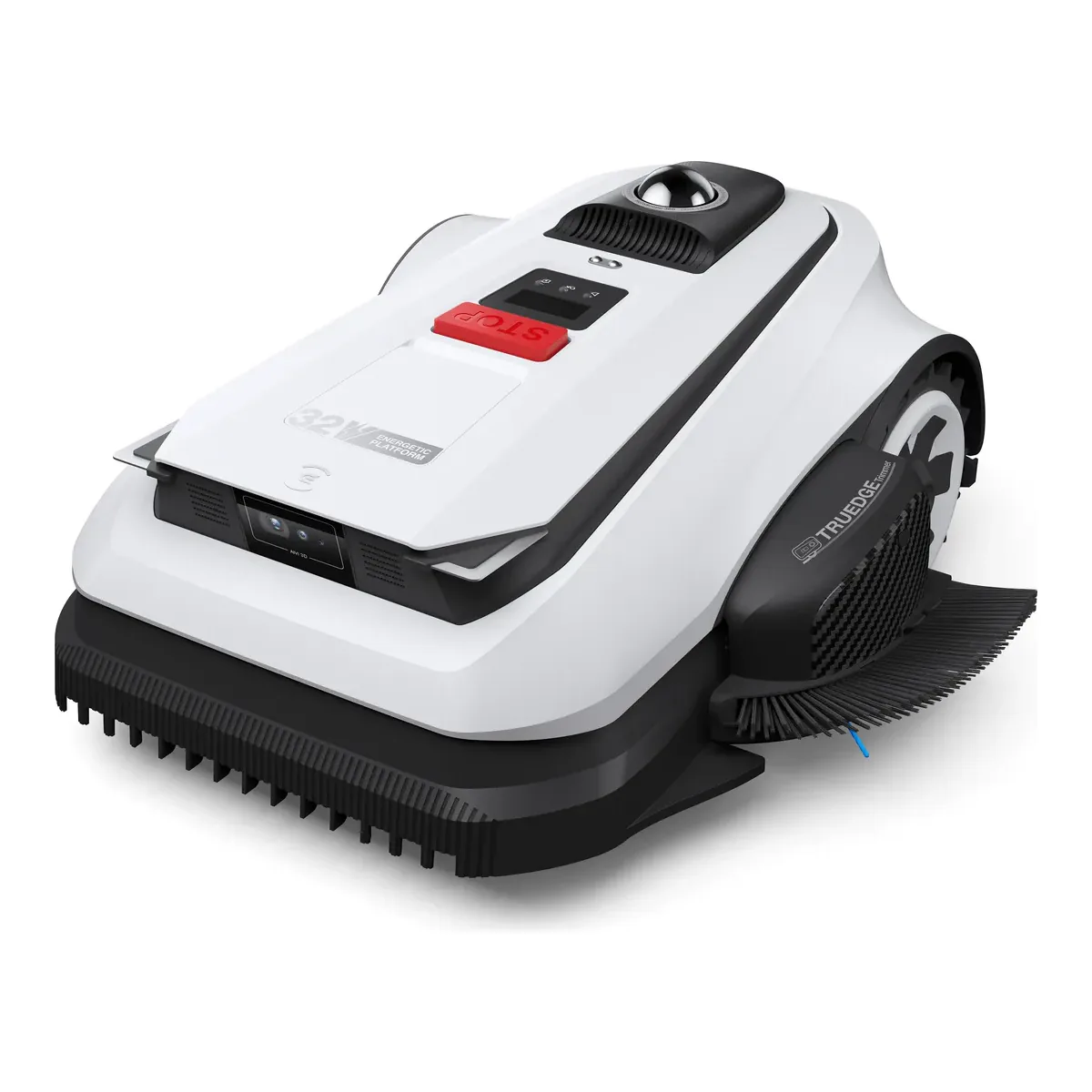
GOAT A2000 LiDAR PRO
Pick this if a lawn well inside half an acre, where the smaller 3.0Ah battery and 50 minute charge never get pushed toward their own rated ceiling.

GOAT A3000 LiDAR PRO
Pick this if a lawn pushing toward 3/4 acre, or a yard the mower has to cross more than once a day, where the 2.5x bigger 7.5Ah battery means more mowing per charge and fewer stops.
| GOAT A2000 LiDAR PRO | GOAT A3000 LiDAR PRO | |
|---|---|---|
| Coverage | 0.5 acre | 0.75 acre |
| Boundary method | Wire-free, multiline LiDAR + AI camera + 3D ToF | Wire-free, multiline LiDAR + AI camera + 3D ToF |
| Max slope | 50% (27°) work area, 20% at the virtual boundary | 50% (27°) work area, 20% at the virtual boundary |
| Cut height | 1.18 to 3.54 in, electric | 1.18 to 3.54 in, electric |
| Obstacle avoidance | 200+ types, 3D ToF + AI camera + LiDAR, avoids from 1.97 in | 200+ types, 3D ToF + AI camera + LiDAR, avoids from 1.97 in |
| Multiple zones | Yes, add, merge and split areas, no-go zones, paths between zones | Not stated |
| Runtime and charge | 50 min (manufacturer) | Not clearly stated |
ECOVACS A2000 vs A3000 comes down to one thing on the GOAT lineup: which battery your lawn is actually asking for. Navigation will not separate them, since both run the same HoloScope 360 dual LiDAR system.
The GOAT A2500 RTK, a separate model ECOVACS also sells, is not part of this comparison at all. It swaps the LiDAR-only setup for a staked antenna and an RTK reference station, which makes it a different navigation architecture altogether. More on that below.
Where the A2000 and A3000 are the same machine
Read the spec tables side by side and most of it matches. Both run Multiline LiDAR navigation with a 3D ToF sensor and an AI camera, wire-free with no physical boundary wire; the boundary is still mapped, automatically or by driving the mower around it. Both carry the same built-in TruEdge trimmer, which ECOVACS's lab rates to leave close to zero inches at the edge. Both also detect and avoid obstacles from as close as 1.97 inches through the same AIVI 3D system, an AI camera paired with the 3D ToF LiDAR; the trimmer plays no part in that. Both spec tables give the same 50 percent (27 degree) slope in the work area and 20 percent at the virtual boundary (the A3000 page's feature copy says inclines of up to 15°, and the spec table is the figure used here), and adjust cutting height across the same 1.18 to 3.54 inch range. Both carry the same IPX6 mower and IPX4 station waterproofing, and neither states a multi-zone scheduling limit. Two things differ. The A3000's own spec table states a noise figure the A2000's does not: 62 dBA at the main body and 82 dBA at the trimmer. For the A2000 there is still no dBA figure, only Digital Reviews Network's hands-on finding that it is "remarkably quiet" when mowing and the trimmer noisier when it spins up. And the A3000's box carries 18 spare blades and a spare trimmer brush, where the A2000's spare kit is 12 blades.
Mowing efficiency is the same number, once the units are converted: the A2000's spec table gives 2,691 to 4,306 square feet an hour and the A3000's gives 250 to 400 square meters an hour. Convert either one and you get the other. Neither model mows faster than the other. What changes is how long each one can keep mowing before it has to stop.
The battery is the entire difference
The A2000 runs a 3.0Ah battery on 113.4W charging, a 50 minute charge time, and a rated coverage up to half an acre. The A3000 runs a 7.5Ah battery, 2.5 times the capacity, on 189W charging, a 70 minute charge time, and a rated coverage up to 3/4 acre. Its spec table prints mowing time per charge as 160, with no unit, against 50 min on the A2000's. Twenty extra minutes of charging buys a battery two and a half times the size and a coverage rating half again as large.
Nothing about that trade is subtle. A buyer choosing between these two model numbers is not choosing a better mower. They are choosing how many stops to recharge their own lawn needs to get finished, and the way to answer that is to measure the lawn. The model number is not a hierarchy.
Who should buy which
The A2000 is the right machine for anything comfortably under half an acre. Paying for the A3000's bigger battery on a lawn well inside the A2000's own rating buys spare capacity that lawn has no use for. The A3000 earns its price the other way around, on a lawn pushing toward the top of its own 3/4 acre rating, or on any yard shaped so the mower has to cross the whole property more than once a day. More battery means more mowing per charge and fewer trips back to the dock. The charge itself is not faster: 70 minutes against 50, so each stop costs 20 minutes more.
When neither is right
If you want a staked RTK antenna in place of a self-contained LiDAR turret, you are shopping for a different ECOVACS model, and a bigger GOAT will not get you there. The GOAT A2500 RTK uses LiDAR-enhanced RTK navigation with a physical reference station and antenna pole planted in the yard, a setup step neither the A2000 nor the A3000 needs at all. Know that model exists before assuming the A2000 and A3000 are the only two ECOVACS options. It answers a different question, though.
And if the lawn has real slope in it, or sits at a size neither GOAT rung fits well, look at the rest of the field before committing to either one. Our robot mower picks carry the A2000 alongside the Mammotion LUBA 3 AWD 5000, rated for 80 percent slopes and a 1.25 acre lawn at up to 0.42 acre per charge, for a yard bigger or steeper than either GOAT handles. For a steeper yard at half an acre, the WORX WR342 is rated for 84 percent. WORX runs its own four rung ladder on the same shelf, compared here, if size, more than navigation, is what actually separates two mowers for you.
ECOVACS A2000 vs A3000, decided in one question
It turns on how much of the rated ceiling the lawn actually uses. Well under half an acre, the A2000 covers it inside its own rating and the A3000's extra battery goes unused. Approaching 3/4 acre, or split across a yard the mower crosses more than once a day, the A3000's bigger pack and fewer stops are the reason to pay more for it. The navigation, the trimmer, the slope rating and the cutting height are the same on both.