ComMarker B4 vs Monport GA60: MOPA or two lenses
Buy the Monport GA60 if a real range of colors on stainless steel is part of the work, or if you want the machine to find focus by itself: it publishes a 2 to 500 ns MOPA pulse range and focuses at one press. Buy the ComMarker B4 50W to mark and deep engrave bare metal across two field sizes, since it ships a 110 mm and a 200 mm lens plus a cage for running it handheld against objects too big for its base.
What decides it: MOPA pulse control and autofocus, against a second lens and handheld use.
We earn a commission on qualifying purchases through the links here, at no cost to you. It never decides what makes the list.
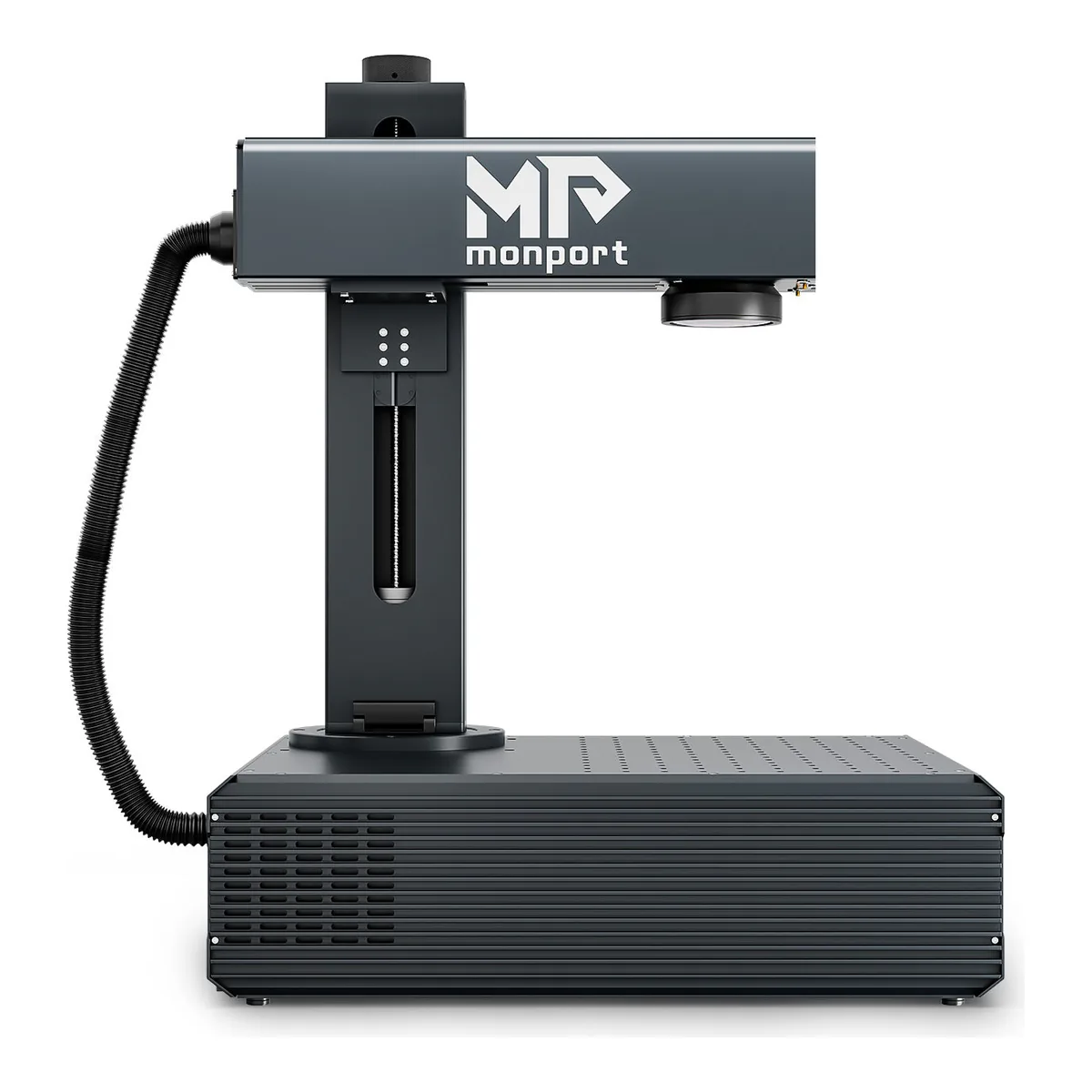
Monport GA60
Pick this if a range of colors on stainless steel, one press focus on flat work, and a listing that already bundles LightBurn and a rotary.
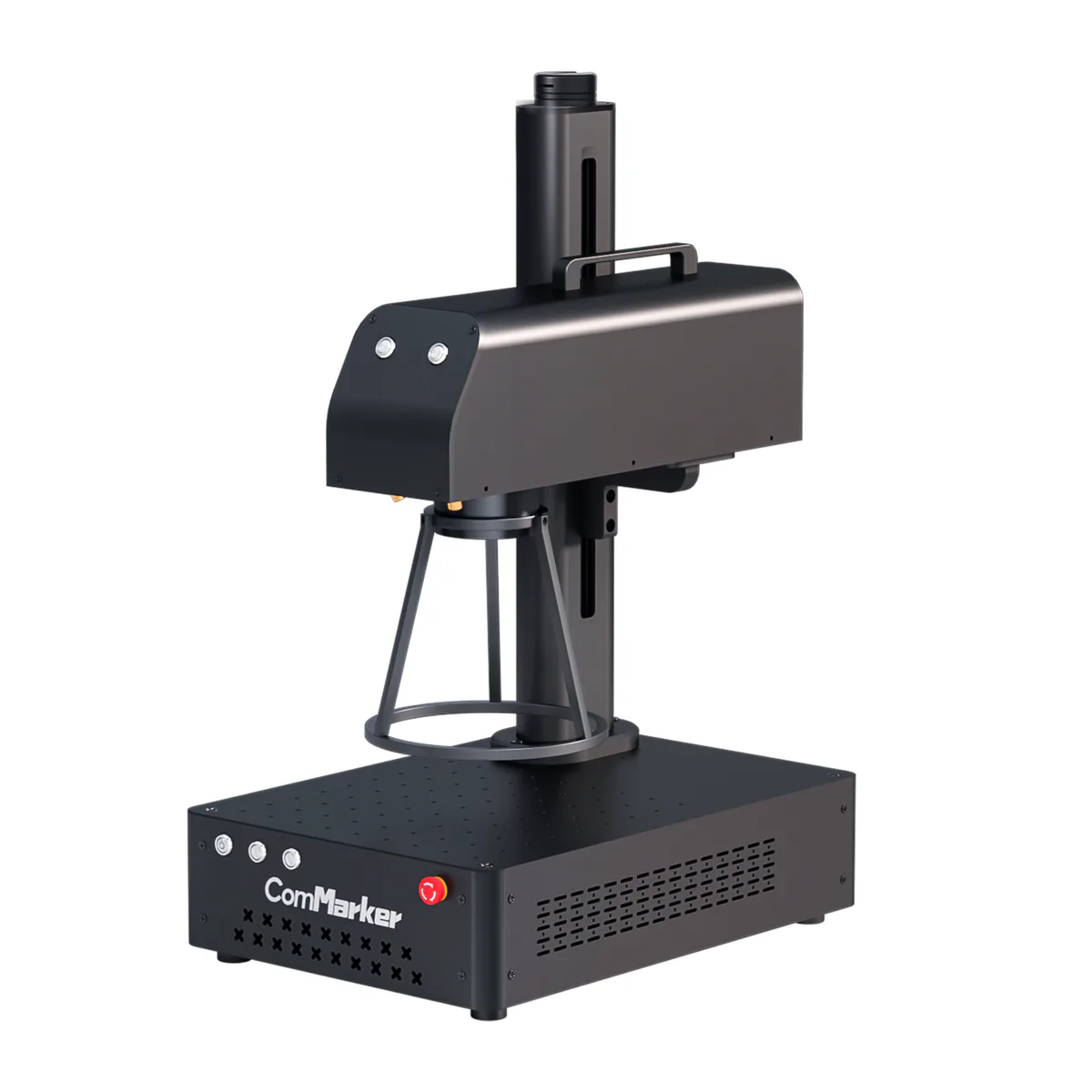
ComMarker B4 50W
Pick this if plain marking and deep engraving on bare metal, a small lens for fine detail and a large one for size, and the odd job held against a surface by hand.
| Monport GA60 | ComMarker B4 50W | |
|---|---|---|
| Work area | 175 x 175 mm (6.9 x 6.9 in), one lens | 110 x 110 mm or 200 x 200 mm, one lens each, both included |
| Laser type | MOPA fiber, 1064nm | Fiber, 1064nm |
| Optical power | 60W | 50W |
| Cuts | Thin sheet metal per Monport, no thickness stated | Light metal cutting per ComMarker, no thickness stated |
| Marks bare metal | Yes, including color marking and deep engraving | Yes, including deep engraving |
| Enclosure | Open frame, Class 4, enclosure sold separately | Open frame, enclosure sold separately |
| Fume extraction | None in the box, fume extractor sold separately | Not stated |
Start with color on stainless steel. If a real range of colors is the job, the ComMarker B4 vs Monport GA60 choice is mostly made for you before the rest of the spec sheet matters. Monport sells the GA60 as a MOPA fiber laser and prints a pulse width of 2 to 500 ns in its own spec table, next to a color engraving row that reads YES. The parameters table in ComMarker's B4 manual runs from output power to weight and has no pulse width row at all. The same manual does publish stainless settings for the B4 20W: light gray, white, gray, black and one dark yellow, so grayscale marks are not the dividing line.
ComMarker does make a MOPA B4. It is a separate 60W rung with a JPT MOPA source, which Hobby Laser Cutters reviewed on its own, and the 50W on our laser engraver shortlist is not it. So read this pair as a MOPA fiber laser against a fiber galvo sold for marking and deep engraving, with lenses and focus as the second question.
ComMarker B4 vs Monport GA60: what they share
More than the wattage gap suggests. Both fire at 1064nm through a galvo head, both makers state 0.01 mm accuracy, and both ship open frame with a Class 4 source and nothing around the beam. Monport's manual says outright that the GA "does not come with a protective housing"; ComMarker's says the B4 uses Class Ⅳ lasers and should never run unattended. Each maker sells an enclosure on the side, and neither puts an extractor in the box.
Neither one does wood. TechRadar found the B4 would mark wood only after it was painted, and Hobby Laser Cutters counts wood and glass among materials no fiber laser engraves. Basis for both paragraphs: manufacturer documentation, plus the hands-on tests named in the sentences.
MOPA pulse and color marking
On the GA60 the pulse is a setting you can turn, across 2 to 500 ns at 1 to 3000 kHz, with a maximum pulse energy of 1.5 mJ on Monport's table. Hobby Laser Cutters, testing a 60W JPT unit, explains what that buys: plastics take a mark more gently and stainless takes color. It also found the colors quickly and still called color on stainless a slow process of test patterns, because every lens and machine combination shifts them. Plain marks on anodized aluminum work on either machine, since the same reviewer says regular Q-switched units mark it well too, and credits careful MOPA settings with black, gray and white on it. ComMarker's own 20W color test on stainless, written up on its blog, came back mostly dark with faint traces of color.
Monport rates the GA60 at up to 0.1mm in a single pass, depending on material. The same reviewer measured 1.3mm in a 25 minute brass relief on the GA60, and the identical depth on ComMarker's 60W JPT MOPA B4 with its 110mm lens.
No cached source measures depth on the 50W.
Lenses and field size
Here the B4 has the larger kit. It ships a 110 mm lens and a 200 mm lens, and its manual lists optional fields of 15, 30 and 40 cm. On a 20W prototype, Hobby Laser Cutters measured a focus spot near 0.05mm on the small lens and near 0.1mm on the big one. The catch is the swap: ComMarker corrects the red light on the 110mm lens at the factory, so fitting the 200mm lens means refocusing and a nine point calibration in CorFile2.
One 175 mm lens is all the GA60 carries. On the JPT unit Hobby Laser Cutters measured a spot of about 60 microns on it, against 50 microns on the B4's 110mm lens on the 20W prototype, and found the lens correction factors already loaded, so straight lines came out straight with no calibration session. A field slightly smaller than the B4's large lens, with nearly the small lens's detail, is a fair trade if you never need 200 mm.
Focus, and objects bigger than the base
The GA60 finds focus at one press, which its listing rates to an error under ±1mm, and its reviewer found it worked every time except on highly reflective objects. The mast rotates up to 90 degrees, and Monport gives a maximum Z height of 410 mm from lens to bench.
On the B4 you set focus by eye, raising its electric lift until the red dots meet.
What it gives back is reach. TechRadar describes a distance cage in the box for handheld work on vertical surfaces and a head that rotates through 180 degrees to clear the platform. The GA60's reviewer noted Monport runs the shortest fiber cable to the head of the machines it compared, and called freehand work on a laser this powerful too sketchy anyway.
Software, the box and the owner record
The GA60 listing we link bundles LightBurn and a rotary axis. Monport's manual requires LightBurn V1.7.00 or later, and its own BslAppSimple runs on Windows only. Nine owners in YouTube comment threads say they own a GA60, and four of them describe trouble between the machine and its software, including a framing command that started engraving instead. One of the nine received a GZTECH source and a BSL controller where the reviewed unit had a JPT source. Ask Monport which source ships. Get the answer in writing. Our Monport GA60 review quotes each of them.
The B4 50W listing title names no rotary. EZCAD2 comes on the USB drive for Windows 7 through 11, and the LightBurn copy beside it is a one month trial with the Galvo license sold separately. Both hands-on tests of the B4 we read were on the 20W, so the case for this rung rests on ComMarker's manual and on the platform every rung shares, which the ComMarker B4 50W review lays out.
When neither is right
If the work is mostly wood, neither machine is the answer, and a diode like the enclosed xTool M2 burns wood natively and keeps the beam in a box, which both fiber galvos leave to you.
If you mean to cut metal you would call plate, neither one gets there. ComMarker describes the 50W as suited to light metal cutting, and the single cut figure on record for the GA60 is a 0.3mm aluminum card in under ten passes. That is a job for a dedicated laser cutter and welder, the class our xTool MetalFab comparison covers.
And if a separate room, an extractor and real OD6+ eyewear for 1064nm are not in the plan, wait on both. Both machines stop at the lens, and the rest of the safety budget is yours either way.