Segway Navimow i215 vs i210: the antenna question
Buy the i215 LiDAR for a yard with real complexity, several sections, heavy tree cover, or when you would rather not depend on a cellular Network RTK signal at all, since it ships with no antenna in any yard. Buy the i210 AWD for a smaller, simpler lawn where Network RTK coverage is confirmed for your address, since its rated coverage is smaller but the antenna kit in the box is a fallback you will most likely never open.
What decides it: The antenna in the box: zero hardware for one, a GNSS antenna kept as a fallback for the other.
We earn a commission on qualifying purchases through the links here, at no cost to you. It never decides what makes the list.
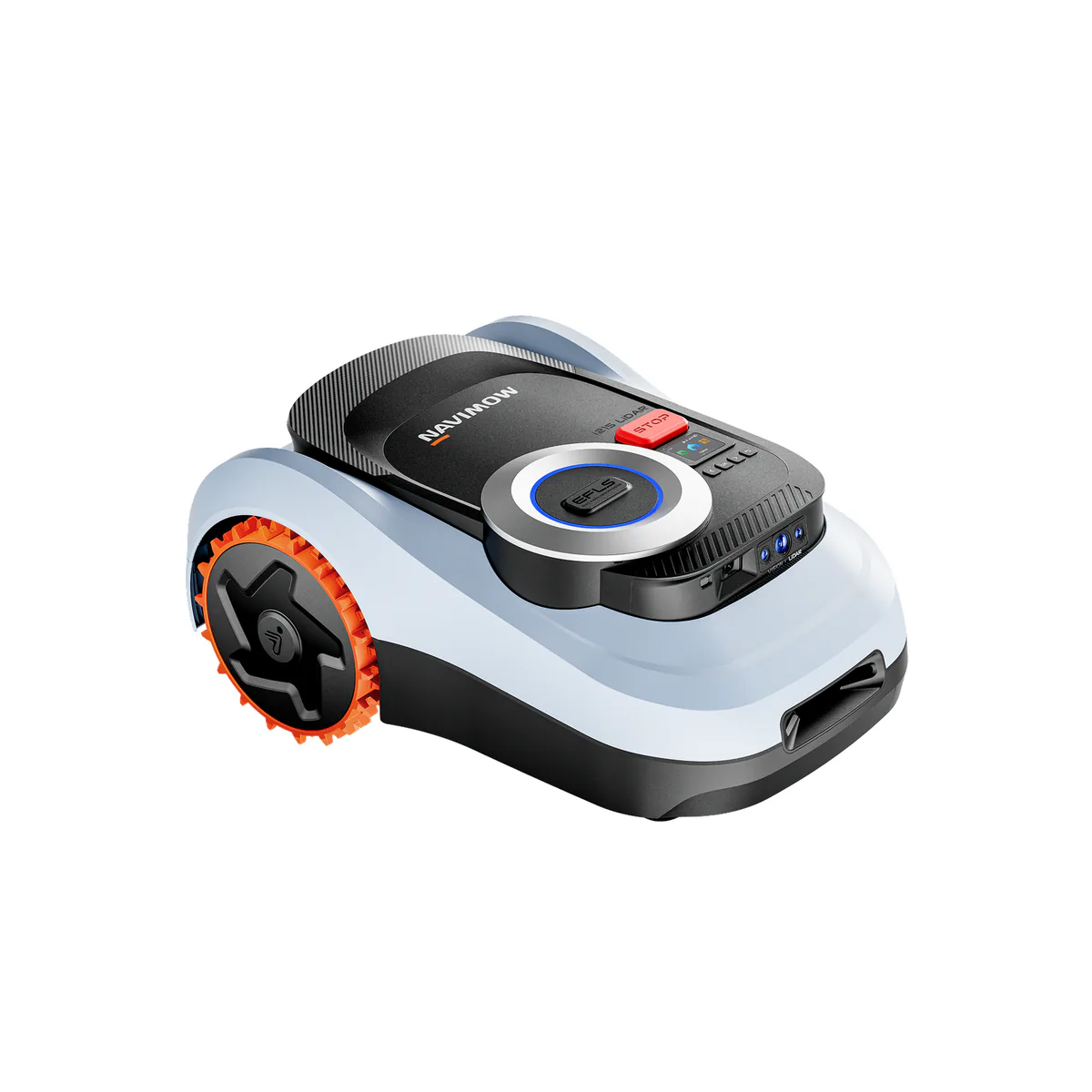
Navimow i215 LiDAR
Pick this if a yard with real complexity, multiple sections, trees or shade, and a buyer who does not want positioning that leans on a cellular signal at all.
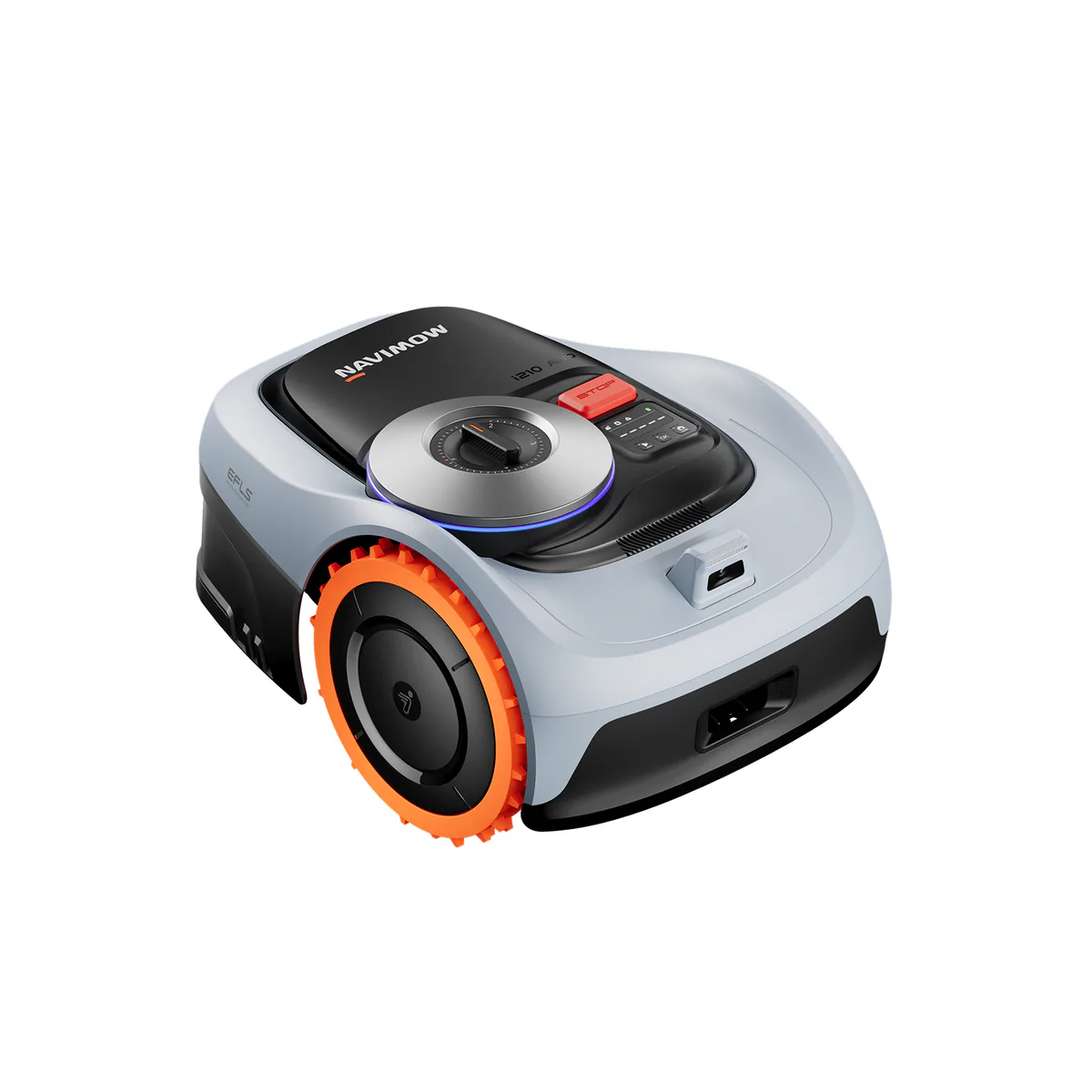
Navimow i210 AWD
Pick this if a smaller, simpler lawn where Network RTK coverage is confirmed for the address, and the antenna kit in the box will most likely stay in its bag.
| Navimow i215 LiDAR | Navimow i210 AWD | |
|---|---|---|
| Coverage | 0.37 acre rated, up to 0.44 acre mappable | 0.25 acre rated, about 0.30 acre mappable (our arithmetic on the stated 1.2x map rule); up to 0.37 acre mowed per 24 hours |
| Boundary method | Wire-free, solid state LiDAR + vision (EFLS), no perimeter wire, no antenna, no RTK hardware in the box | Wire-free, Network RTK + vision (EFLS NRTK); box includes a GNSS antenna and installation kit as a fallback where Network RTK coverage is weak |
| Max slope | 45% (24°) inside the working area, 25% (14°) at the boundary | 45% (24°) inside the working area and at the boundary |
| Cut height | 2 to 4 in, or 0.8 to 2.8 in with the low cutting kit in the box | 2 to 3.6 in |
| Obstacle avoidance | 200+ types detected, 0.4 in precision | 150+ types detected (VisionFence) |
| Multiple zones | Up to 20 zones | Up to 20 zones, all drawing on one shared map budget |
| Runtime and charge | 7.65 Ah / 165 Wh battery, about 160 min mowing per full charge covering 0.105 acre, about 130 min to recharge | 5.1 Ah / 110 Wh battery, 120 min mowing per full charge covering 0.06 acre, 120 min to recharge |
Segway Navimow i215 vs i210 is not the generation question it looks like. Both carry a new-arrival tag on Segway's own store on the same day, and both ship a January 2026 manual revision, and what splits them is architecture: one reads the lawn with a solid state LiDAR, the other with a network positioning signal. That antenna is where the split actually shows up. Not where most buyers expect it.
What antenna free actually means on each one, and it is not the same claim twice
Segway's own i210 AWD product copy promises antenna-free installation wherever Network RTK coverage reaches, with no local antenna to plant. Its box still ships a GNSS Antenna and an Antenna Installation Kit, and the i2 AWD user manual says what they are for: "If the Network RTK service is not supported in your area, install the antenna with the tools provided in mower box." The claim is conditional, and the document that matters states it as one. Segway is not contradicting itself here.
By contrast, the i215 LiDAR's claim is a plainer one: no antenna, full stop. Its own box list carries a charging station, a power supply, spare blades and a low cutting kit, and nowhere does an antenna or a reference station appear. PCWorld's hands-on review of the i215 confirms it from the outside: "No perimeter wire or external antenna required" tops its list of pros. Neither machine lies about its hardware. One architecture can need a piece of it depending on where you live, and the other was built not to need it anywhere.
Basis: manufacturer documentation for both, corroborated for the i215 by PCWorld's own hands-on test.
Coverage, size and what a bigger sensor costs in footprint
Rated coverage splits them further: 0.25 acre for the i210 AWD against 0.37 acre for the i215 LiDAR, with Segway's own FAQ naming a maximum mappable area up to 0.44 acre depending on yard layout. That extra headroom comes with a bigger machine. Its own manual puts the i215 LiDAR at 25 by 17.6 by 11.3 inches and 32.41 lbs, against 21.4 by 15.1 by 11.2 inches and 27.12 lbs for the i210 AWD. Segway's own product page writes the i215's width as 17.5, in both its FAQ and its spec table. Where a datasheet and a product page disagree on a nominal spec, this site takes the datasheet. The i215 also carries more hardware, a LiDAR module and a motor Segway rates at 100W peak driving six blades, against the i2 AWD series' single disc of five. Segway does not say the one causes the other, and we do not either.
Battery is where the bigger body pays off. A 7.65 Ah, 165 Wh pack gives the i215 about 160 minutes of mowing on a charge and about 130 minutes back on the station, against 5.1 Ah and 110 Wh for about 120 minutes each way on the i210 AWD. So the LiDAR machine mows a third longer per charge. Of the two, only the i215 recharges faster than it mows, which is what lets it cover 0.105 acre between trips to the dock against the i210's 0.06.
Basis: both user manuals and both product pages, which agree. Each manual conditions its runtime on a standard cutting speed at 77 degrees F over a freshly cut lawn, and says outright that wet or long grass cuts the working capacity.
Obstacle detection widened with it. Segway states 150 or more obstacle types for the i2 AWD series the i210 belongs to, and 200 or more at a stated 0.4 inch precision for the i215 LiDAR specifically. Every robot mower's obstacle detection is a vision or LiDAR claim rather than a physical guarantee, and how much to trust one is covered on the boundary decision page.
Slope is the second place they split, and only one manual says so
Both product pages advertise the same 45 percent, 24 degree climb, rated on dry grass at a 1.97 inch height with nothing in the way. Both manuals carry a second incline limit beside it that no marketing copy repeats, for the grade at the boundary rather than inside the working area. On the i2 AWD series that boundary figure is the same 45 percent. On the i215 LiDAR it is 25 percent, 14 degrees, and the i215's own safety warning spells out the pair: do not mow slopes steeper than 45 percent inside the working area, or 25 percent at the boundary.
That is close to half the grade at the one place a robot mower is most likely to slide off, and it lines up with what Segway says elsewhere about this model, that compared to the i2 AWD the i215 LiDAR suits flatter and larger lawns. The threshold is what matters, not the direction. A perimeter under 25 percent is inside both machines' rating and decides nothing. Between 25 and 45 percent only the i210 AWD is rated for it. Read the 45 percent on either box as a work area number and go looking for the boundary one, because that is the pair that decides a sloped edge.
Cutting height took longer to pin down, because the marketing copy carries no range and the only figure in the i2 AWD page's own prose is a footnote fixing the blade at 3.6 inches for its vertical-step test. It is in the specification tables, which both product pages build in JavaScript and which a plain fetch of either URL never returns. The i2 AWD series gives 2 to 3.6 inches across a row covering the i210 AWD and its smaller sibling alike, and the i2 LiDAR manual gives 2 to 4 inches for the i215. PCWorld's hands-on test lands on the same ceiling from the outside, running the i215 at its 4.0 inch maximum before dropping it to 3.2. So the LiDAR machine cuts under half an inch taller at the top of its range, on a cutting width of 8.66 in against 7.1. That matters on a lawn deliberately kept long and nowhere else. More room opens up at the other end, the half nobody mentions: a low cutting kit ships in the i215's box and drops its range to 0.8 to 2.8 inches, well under anything the i210 AWD will do.
The gotcha a spec sheet does not carry
PCWorld's reviewer flagged something to know before the i215 LiDAR goes near a raised lawn edge. It is specific to the machine they had in the yard, so read it as an i215 finding and not one about every Navimow. The i215 has no dedicated cliff sensor, the kind that reads a sudden drop the way a robot vacuum does. A narrow strip between their test lawn's grass and a fence caused the mower to slip off the turf a couple of times during actual mowing, even though it had mapped cleanly around that same edge beforehand. PCWorld's own reading is the fairer one, and we carry it over: the mower appeared to be following the boundary it had mapped, and the physical edge simply gave it very little room for error. Segway's marketing copy never mentions the limitation. It reads as a lived edge case with no spec line behind it, the kind of detail a listing page was never going to carry.
When neither Segway is the right question
A buyer sold on the staked-antenna approach specifically, and not on Segway's network version of it, should read our ECOVACS staked RTK comparison instead. It covers a brand that ships a physical reference station and does not lean on cellular coverage. And if navigation architecture is still an open question for you, see how the wider shelf stacks up. WORX's RTK Cloud and Mammotion's Tri-Fusion LiDAR answer this same question two more ways there.
Segway Navimow i215 vs i210, decided by what is actually reachable at your address
Confirm Network RTK coverage for your address first. Where it holds, the i210 AWD covers a smaller lawn in the smaller of the two bodies. No other size difference has support in either document. Neither Segway nor PCWorld publishes a turning radius for either machine. Where coverage is weak, patchy, or you would simply rather not find out, the i215 LiDAR's antenna-free design and its larger rated coverage are worth the extra footprint, provided you keep an eye on any raised edge it has to ride along.