JET Deluxe XACTA review: 50 inches of rip on 230 volt only
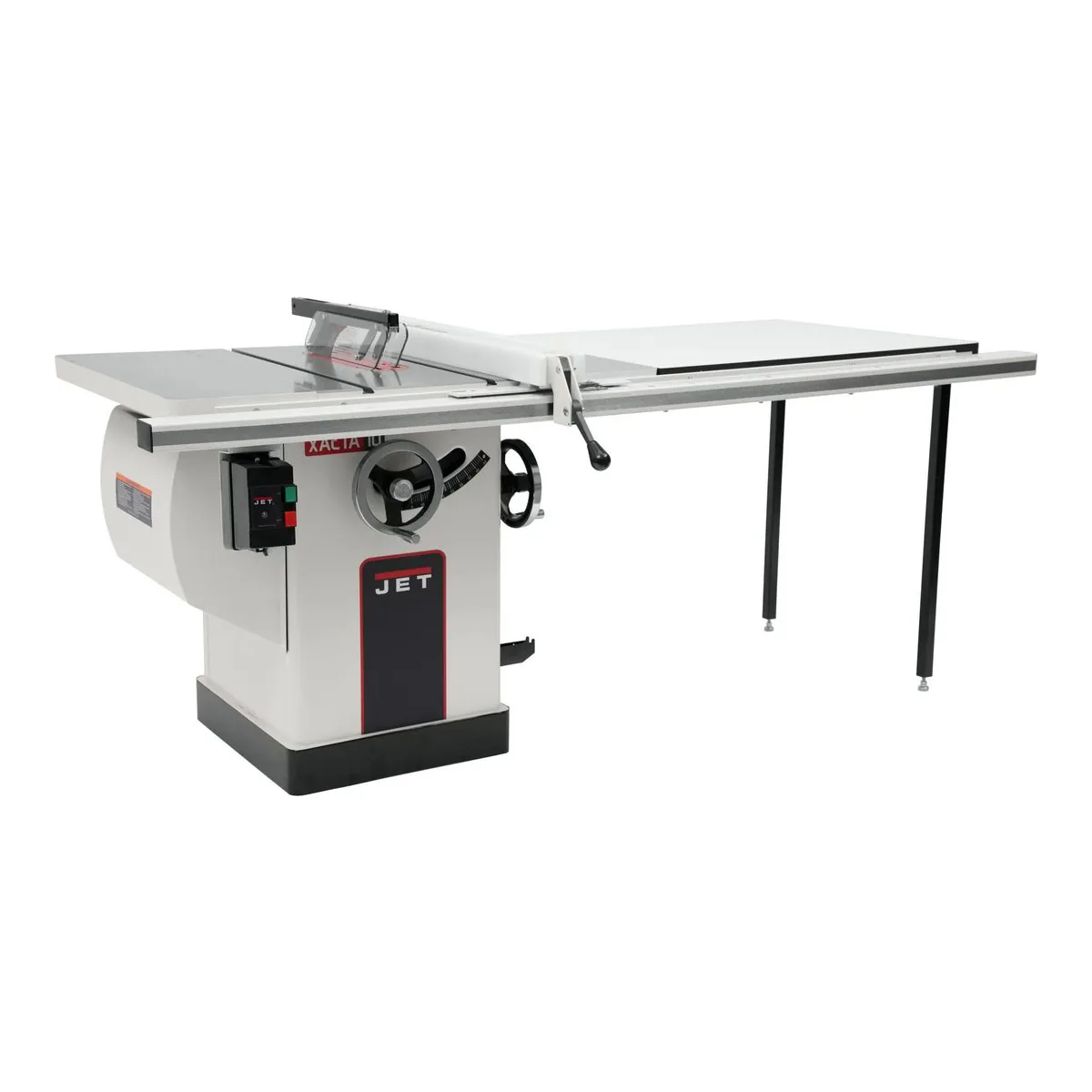
The JET Deluxe XACTA is a 3 HP cabinet saw built entirely around 230 volt power and a 50 inch rip, with no 120 volt fallback and no flesh-detecting brake, for a shop that already has the circuit and wants the cast iron over the safety feature.
- 3 HP motor on 230 volt single phase power
- 50 inch rip capacity right of the blade
- 10 inch blade on a 5/8 inch arbor, and a cast iron table
- 3 inch maximum depth of cut, 4 inch dust port
- Takes a 13/16 inch dado stack up to 8 inches in diameter
We earn a commission on qualifying purchases through the links here, at no cost to you. It never decides what makes the list.
The reviewer who tested the JET Deluxe XACTA for NewWoodworker.com stopped mid-writeup to note what was not in the crate: no blade, no power cord, no plug. He was untroubled by it. Nobody at the factory can guess which 220 volt outlet a buyer has or which blade they want, so JET leaves both out and takes a little off the price. He thought that sensible, not stingy. His test is from 2011 and JET's current spec sheet says nothing about what is in the crate, so treat it as the shape of this saw. It promises nothing about today's carton, and you should ask the seller before ordering a blade with it.
Almost everything else about the JET Deluxe XACTA follows the same logic. It is a JET cabinet table saw built around one voltage, one rip capacity and one fence system, sized for a shop that has already committed to 230 volt service. It makes no effort to suit whoever happens to plug it in. As a 50 inch rip table saw it sits at the wide end of this shelf, and the fence is most of what a buyer is paying for. Expect to meet more than one name for it. JET's own product page gives the model as JTAS-10DX-350 with a stock number of JT9-708675PK, and the Amazon listing prints JTAS-10XL50-1DX, all against the same 50 inch rip, 3 HP and 230 volt single phase.
Same specs, different labels.
What we read: JET's own specification sheet, the live Amazon listing, and a real hands-on test from Tom Hintz at NewWoodworker.com. Hintz ran this saw against his own Powermatic dust collector and checked its factory alignment with a dial indicator before writing a word about it.
The owner evidence is thin. It is also not empty, so here it is. Four video threads name this saw, 27 comments between them, and 23 of those sit under a single critical review of one unit's finish. Nobody in the thread pins down which XACTA that unit was, so read the whole cluster as being about the family. None of it is provably about this 3 HP 50 inch build. Eight people there call the machining or finish poor and four of the eight say they will not buy the saw. Not one of the eight owns it.
Four people in that thread do, and none of them reports a saw that does not work. One has had an XACTA for ten years, says it is a great saw, and is puzzled that the video's unit looks nothing like his. One had just taken delivery and says his arrived mint. A third argues the rough corner castings have no effect on performance and are the compromise at this price tier, and says his own saw is all he expected, comparing it favorably to Powermatic and Unisaw machines. A fourth bought one in March 2023 as a warehouse return, reports a few scratches and the cabinet drawer the 2011 test praised now missing, and had not yet cut with it. Five other commenters argue the review judged paint and not function.
So the split is about cosmetics. Nobody is arguing about cutting, and a cosmetic split this mixed cannot carry the verdict, so the rung here stays documentation. Finish is also not something JET's spec sheet makes any claim about either way.
JET Deluxe XACTA rip capacity: 50 inches, on a fence built for it
Fifty inches to the right of the blade is the number that puts this saw on the shelf at all, and it comes from the JET XACTA-FENCE II riding a 50 inch rail. The independent test calls that fence system "as tough as it is accurate," and its faces are a pair of 3/4 inch thick HDPE slabs. He contrasts them with the common and cheap laminated wood other fences use. They stayed slick through a considerable amount of ripping, and the tester never waxed them. The fence squares to the table and to the miter slot with adjusting screws at both ends of its T-square arm, and a magnified cursor lens over the factory scale tape makes the cut width easy to read. Its locking handle is deceptively easy to operate, built from powdered-metal parts, and the tester wrote that it took him several uses to grow accustomed to how easily it locks the fence securely in place.
One asterisk on the setup comes from the tester himself: the arbor came parallel to the miter slots with no adjustment needed, but he did tweak the fence parallelism slightly to reach his preferred 0.002 inches of clearance at the rear. That was the only adjustment the saw wanted.
Left of the blade you get 12 inches. That figure settles whether a crosscut sled clears the frame. The test also noted a 30 inch XACTA fence available alongside it; this is the 50 inch configuration.
A 3 HP motor that only ever runs on 230 volt
This is the sharpest difference between the XACTA and the two SawStop saws on this same shelf. The two SawStop saws here both ship pre-wired for 120 volt and convert to 220 for a lighter amp draw, never more power, and only after a contactor box bought separately from SawStop. The JET Deluxe XACTA skips that choice: JET's sheet lists its motor voltage and its prewired voltage as 230, with no 120 volt mode offered at all. The tradeoff runs opposite to the JET ProShop II, which ships on this shelf as the 120 volt build for shops without 230 volt service, though JET builds that saw in a 230 volt version too.
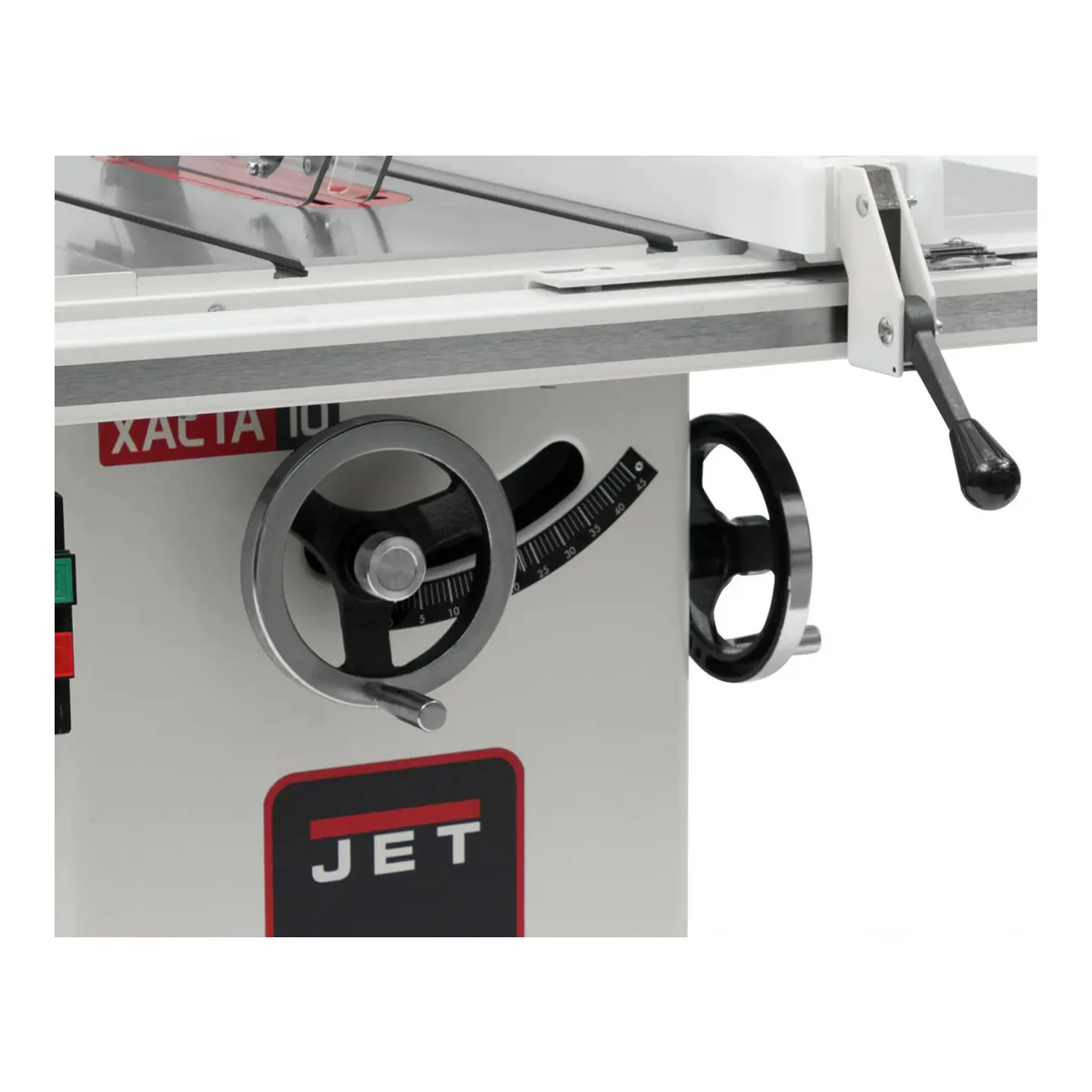
The independent test is specific about what 3 HP means on this saw: JET rates it on a continuous duty cycle, not the peak or "max developed" figure some brands print. The tester found the motor delivered every bit of that power in practice. Nothing else we read covers the drivetrain: power reaches the arbor through a Poly-V belt in place of a conventional V-belt. He associates that with less slip and a cooler-running belt over time, and JET's cached spec sheet says nothing about the belt at all. An industrial magnetic switch sits between the outlet and the motor. Know its two jobs before the first cut. It drops out on a power fluctuation that would drive the amp draw up, faster than a person can react. And it will not restart the saw on its own once power returns. If the shop loses power mid-cut, somebody has to walk over and press the on button again. A 14.5 amp draw at 230 volt is what JET's own spec sheet lists, and the recommended circuit is 20 amp.
Depth of cut, dado capacity and the arbor lock
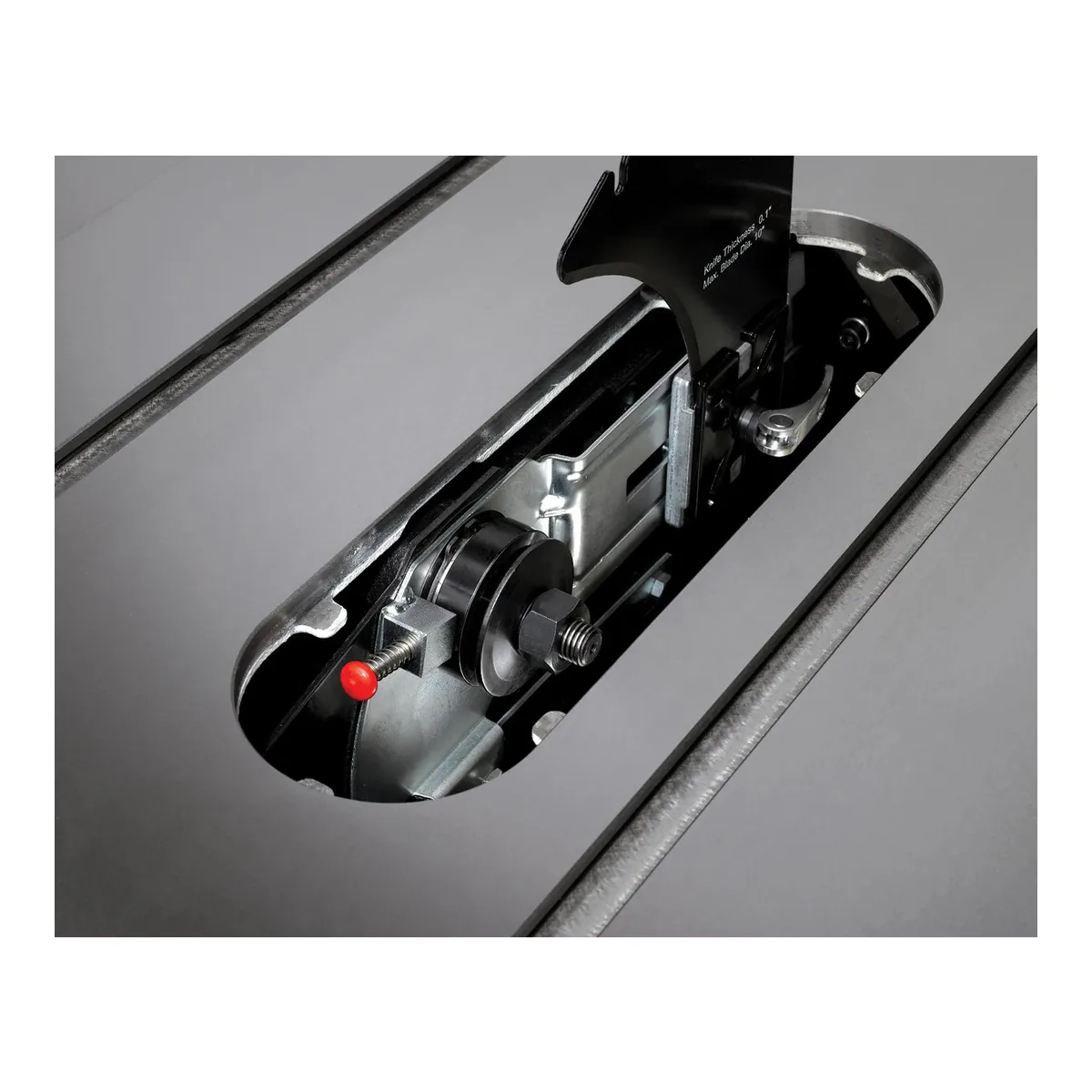
JET's spec sheet gives maximum depth of cut as 3 inches on a 5/8 inch arbor. The independent test adds what the sheet does not: that arbor is full length, carried on both sides by sealed ball bearings in a heavy cast iron arm. This table saw dado capacity is a 13/16 inch wide stack at up to 8 inches in diameter. The independent test judged the arbor long enough to take most stacked dado sets at that full width, with the 3 HP motor behind them.
Do not pick this saw over the SawStops for that ceiling. The CNS175's manual publishes a 29/32 inch dado width in its spec table, then instructs owners never to stack one thicker than the same 13/16 inch the JET allows. Build around 13/16. A dado on either SawStop also wants the optional dado brake cartridge and insert. The dado width is a tie. The 3 HP behind it is the difference, and no cached test here ever ran a stack to prove what that buys you.
A pushbutton arbor lock makes a blade change a one-hand job, with no two-wrench wrestling match, and the test found an offset wrench in the box, shaped so your knuckles stay further from the teeth while you use it. JET's sheet gives the cast iron table as 29 by 20 inches, and the 2011 test gives it as a finely ground 29 by 42 with the extensions fitted. Alignment is a separate finding and a good one: the independent test checked the factory setup sheet against his own dial indicator and found it accurate. Table height sits at 34 inches, and the front of the blade at maximum depth sits 10 inches back from the table's front edge. A sled or a wide panel gets that much infeed room before the cut starts.
The riving knife, the guard, and the brake this saw does not have
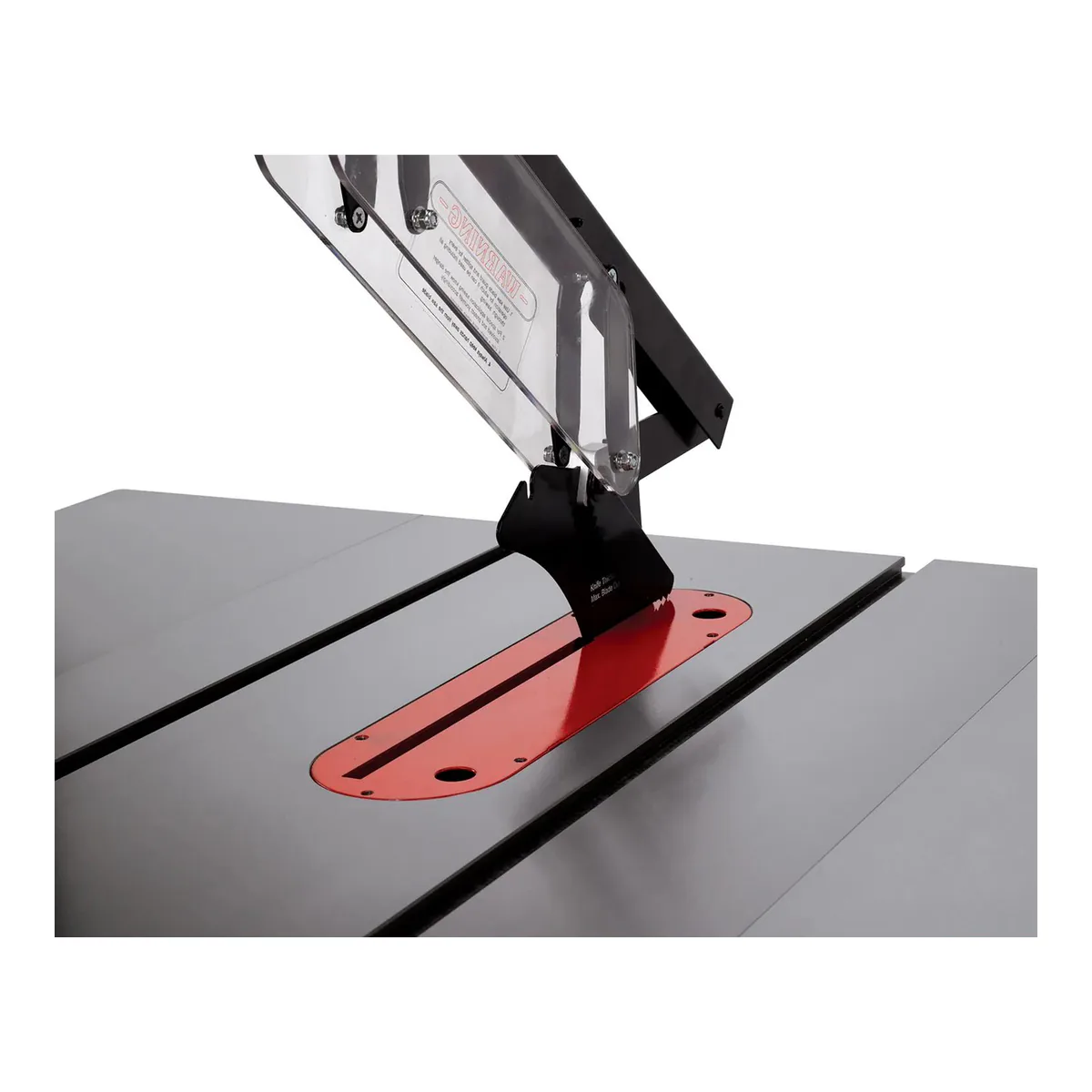
The safety hardware is the part of this saw with the thinnest paper trail: JET's current spec sheet lists no guard, riving knife or arbor lock at all, so everything in this section comes from the 2011 test and inherits its age. It found a riving knife mounted on the same boss as the arbor, so the knife tracks height and bevel changes without a separate adjustment. It also found a modular blade guard splitting into independent side panels that lift clear of the workpiece one at a time instead of as one fixed cover. The independent test found the guard system almost identical to the one on Powermatic's PM2000 cabinet saw and just as easy to live with. In a guard, ease of use counts most, because it decides whether the guard stays on.
What it does not have is a flesh-detecting brake. The SawStop PCS175 above it on this shelf stops and drops the blade on skin contact, and nothing in JET's documentation for this saw offers an equivalent. That absence is not unique to it. The only picks on this shelf that stop a blade on skin contact are the two SawStops, so the choice really is for or against that one brand. Skip this saw entirely if you are shopping for the brake, because a riving knife and a good guard reduce a kickback and a push-stick habit reduces a finger injury, but neither one is the same protection a brake gives.
Dust collection: a 4 inch port on 350 CFM
JET's spec sheet asks for 350 CFM through the saw's single 4 inch port. Check that against whatever collector already serves the shop. A shared 4 inch port does not mean a shared airflow number. The independent test found "very little dust" on the table even while cutting 2 inch oak with a combination blade and the standard throat insert, and very little inside the cabinet across the whole evaluation, connected to a Powermatic PM1300. A spec sheet alone cannot give that kind of real-use confirmation. The tester credits the wraparound shroud below the table, which is bolted to the same arbor boss as the blade, so it follows every height and bevel change and keeps its seal instead of gapping open at some settings and not others. Sizing a dust collector to a machine's real draw, and not to its port diameter, is the question this shelf's dust collector hub exists to answer.
What keeps this saw running the way it arrived
The independent test closes on upkeep: wax the cast iron, clear the dust often and recheck alignment now and then, and the saw should keep performing for a very long time. Call it maintenance. Nothing there is repair, and a heavy cast iron trunnion and a precision fence ask for it in exchange for holding their settings.
Buy the JET Deluxe XACTA if a 230 volt circuit is already in the shop, or going in with this saw, and a wide fence and 3 HP behind the blade matter more than a safety brake. Skip it if the shop has no 230 volt circuit yet and adding one is not on the table this year. On this shelf, unlike the SawStop pair reviewed alongside it, this saw carries no 120 volt mode to fall back on: only the 230 volt the motor was built around from the start.
A closer look at the JET Deluxe XACTA
Made up your mind?